Home > Blog > Cancer > Cancer Surgery > Surgery English > Radical Nephrectomy
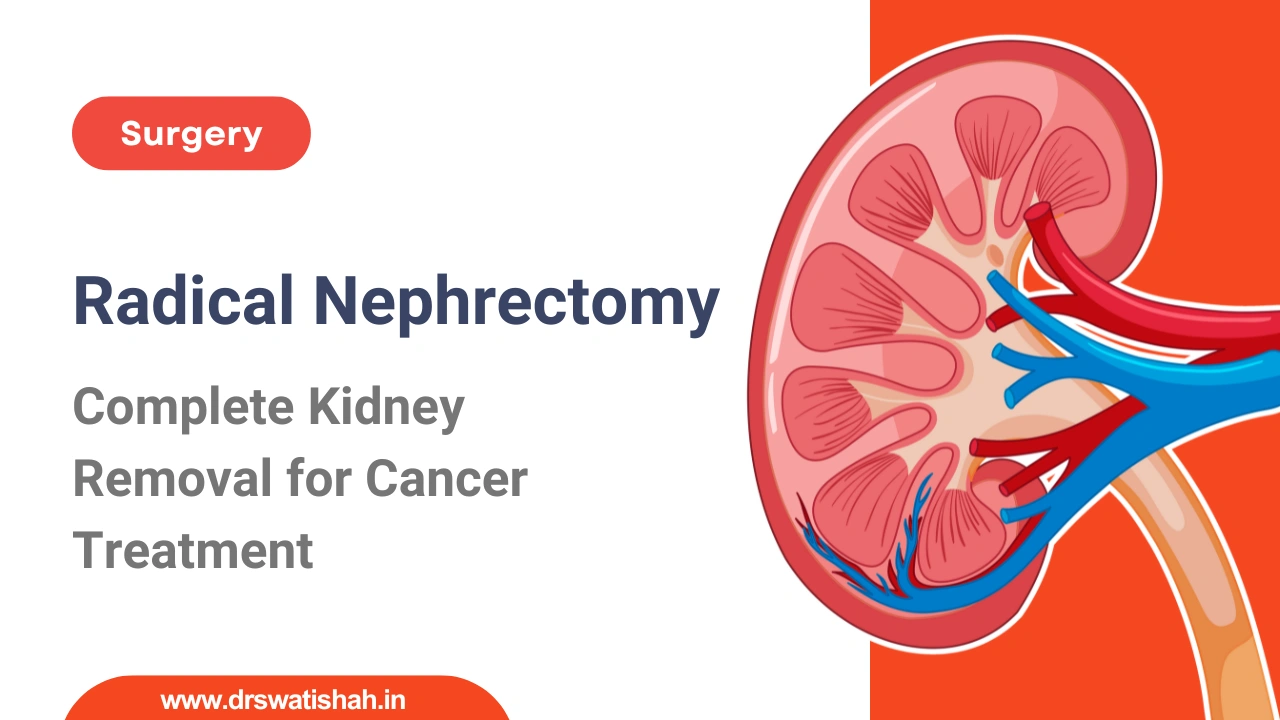
The human body is a wonderful machine, and the kidneys are some of its most important parts. Most of us are born with two kidneys, located on either side of the spine, deep inside the upper back. They work 24 hours a day to clean our blood, balance fluids, and make urine.
However, sometimes life throws a challenge our way. Due to serious diseases like kidney cancer, severe infection, or major injury, doctors may decide that one of the kidneys must be completely removed.
When a doctor suggests surgery to remove the entire kidney, the medical term used is Radical Nephrectomy. Hearing that you or a loved one needs this surgery can be very frightening. It is a major operation, and it is normal to have many questions. How will life change? Is it safe? How is it done?
This detailed guide is written specifically for you. We have used simple, general English so that anyone in India—from a student to a grandparent—can read and understand it easily. We will cover everything from the basic definition to the recovery process, ensuring you feel prepared and confident.
To understand the surgery, we must first understand the name. “Nephro” relates to the kidney, and “ectomy” means to cut out or remove. Therefore, a nephrectomy is the removal of a kidney. But what makes it “radical”?
This procedure involves the complete surgical removal of the entire kidney, along with the ureter, adrenal gland, and surrounding fatty tissue. Unlike a partial nephrectomy where only the tumor is excised, this approach ensures that all potentially diseased tissue is eliminated.
It is often the standard treatment for larger or more complex kidney tumors where preserving the organ is not feasible.
The radical nephrectomy definition is the surgical removal of the entire kidney, along with the surrounding fat, the tube that connects the kidney to the bladder (the ureter), and often the adrenal gland that sits on top of it.
The main objective of a Radical Nephrectomy is usually to treat cancer. When a tumor is found in the kidney, doctors want to make sure they remove every single cancer cell.
If they leave even a small piece behind, the cancer could grow back. By performing a “radical” removal, they take out the kidney and a “safety margin” of healthy tissue around it. This ensures the best chance of a cure.
During this surgery, the surgeon does not just pluck out the kidney. They remove a “package” of tissues to be safe. Understanding the radical nephrectomy anatomy helps explain why this is necessary. The kidney is wrapped in a layer of fat and a cover called Gerota’s fascia.
When the surgeon operates, they typically remove:
⦿ The Kidney: The main organ.
⦿ Perinephric Fat: The yellow fat that cushions the kidney.
⦿ Gerota’s Fascia: The thin envelope of tissue surrounding the kidney.
⦿ The Ureter: Part of the tube leading to the bladder.
⦿ Lymph Nodes: Small glands nearby that trap cancer cells.
⦿ The Adrenal Gland: Often, the radical nephrectomy adrenal gland removal is included because this gland sits directly on top of the kidney, and cancer can easily spread to it.
Dr Swati Shah writes on recovery after surgery, which symptoms need a scan, and the questions patients actually ask in OPD. No advertising.
Your number is used for this letter and for the clinic to reach you. It is never sold or passed on. To stop, reply STOP on WhatsApp.
For example, if you are undergoing a laparoscopic radical nephrectomy right side procedure, the surgeon will make these small holes on the right side of your abdomen. They insert a long, thin tube with a camera (laparoscope) into one hole. This camera shows the inside of your body on a TV screen. They use long instruments through the other holes to cut the kidney free.
⦿ Removal: Once the kidney is loose, they put it inside a special plastic bag inside your tummy and pull it out through one of the cuts (which they make slightly bigger, about 2-3 inches).
⦿ Benefits: Less pain, shorter hospital stay, and a faster return to work.
| Feature | Open Surgery | Laparoscopic Surgery | Robotic-Assisted Surgery |
|---|---|---|---|
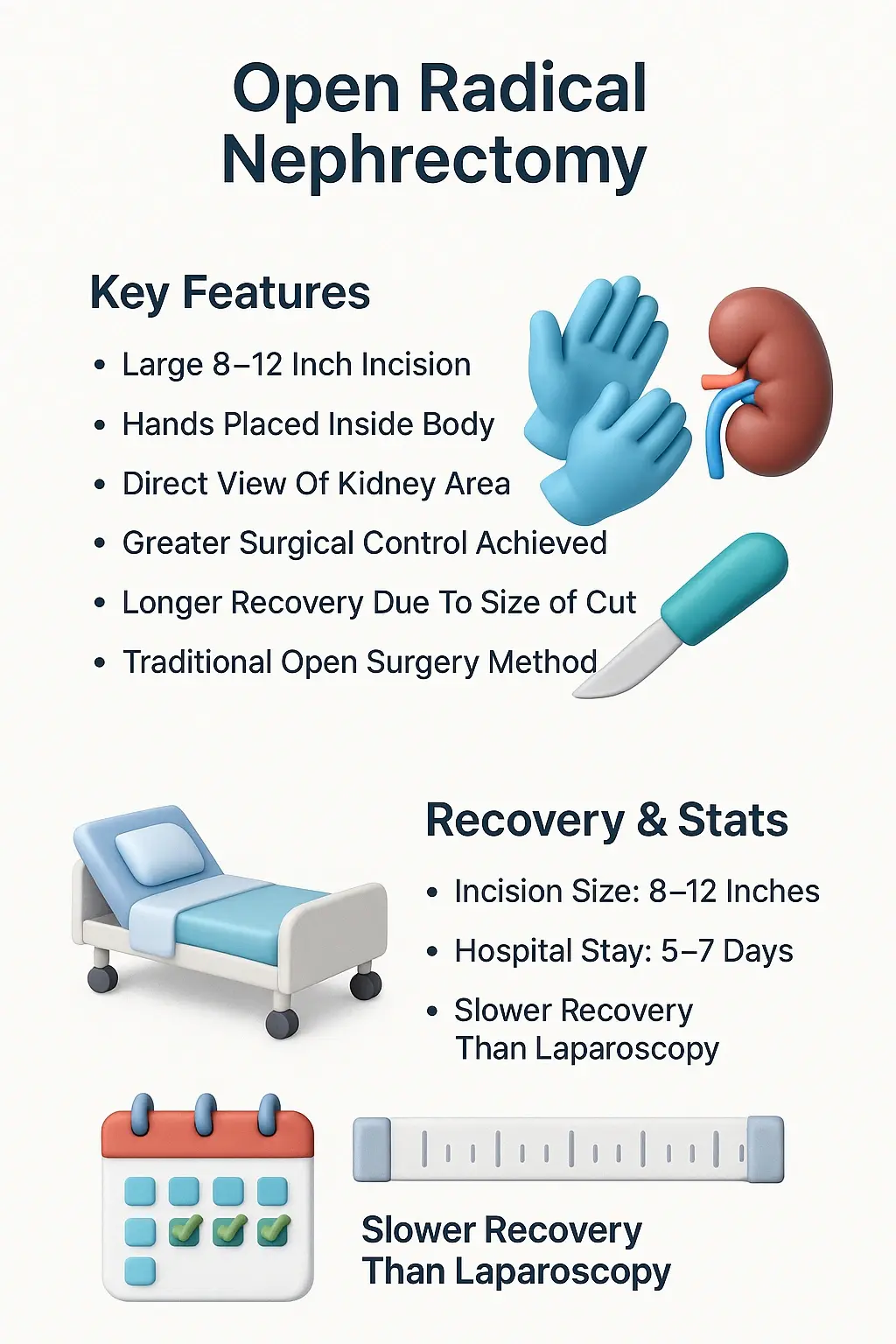
| Incision Size | Large (8-12 inches) | Small keyholes (0.5-1 inch) | Small keyholes (0.5-1 inch) |
| Blood Loss | Moderate to High | Low | Very Low |
| Hospital Stay | 5-7 Days | 2-3 Days | 2-3 Days |
| Pain Level | Higher | Mild to Moderate | Mild |
| Surgeon Control | Direct Hand Contact | Long Instruments | Robotic Precision Arms |
| Cost | Generally Lower | Moderate | Higher |
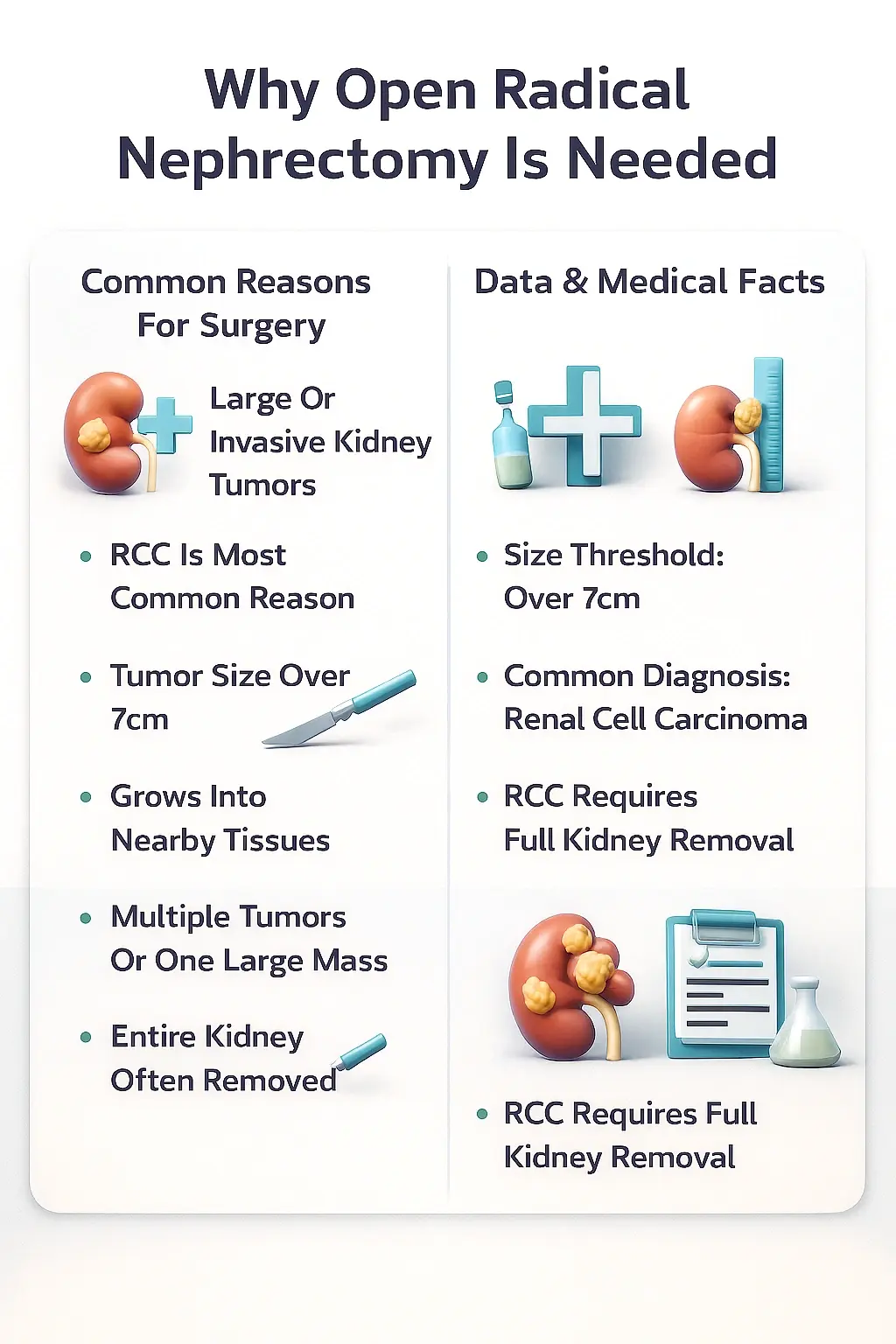
The most common reason is kidney cancer, specifically Renal Cell Carcinoma (RCC). Doctors look at the “Stage” of the cancer.
⦿ Stage 1: Tumor is small (less than 7cm) and inside the kidney.
⦿ Stage 2: Tumor is large (more than 7cm) but still inside the kidney.
⦿ Stage 3: Tumor has grown into veins or nearby fat.
If you look at a radical nephrectomy diagram, you will see that when a tumor gets very big, it stretches the kidney and invades the center where the blood vessels are. In these cases (Stage 2 and 3), trying to save part of the kidney is too dangerous. The whole thing must go to ensure the cancer is gone.
It is not always about cancer. Sometimes, a kidney dies due to other causes.
⦿ Infection: Severe, long-term infection (chronic pyelonephritis) can turn the kidney into a bag of pus that makes the patient sick.
⦿ Stones: Massive kidney stones that have blocked the organ for years can destroy it.
⦿ Trauma: A bad car accident or fall might shatter the kidney beyond repair.
⦿ Hypertension: A shriveled, dead kidney can release chemicals that cause dangerously high blood pressure. Removing it helps cure the blood pressure issue.
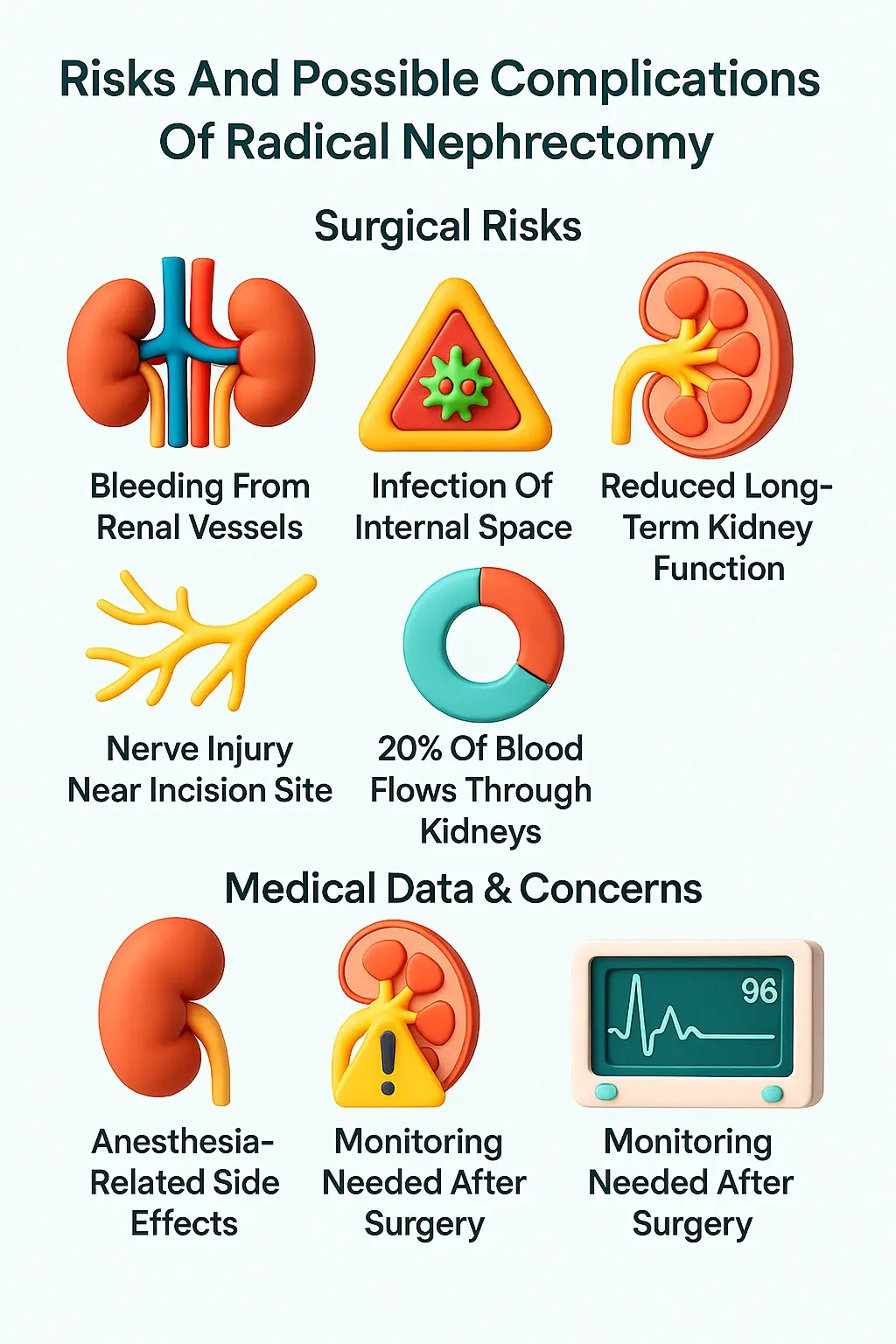
The kidneys handle 20% of the blood pumped by the heart. They are connected to the body’s largest artery (Aorta) and vein (Vena Cava).
⦿ Bleeding: During surgery, the doctor cuts these large vessels. While they are tied off securely, there is a small risk of bleeding.
⦿ Infection: After surgery, the wound site or the internal space can get infected. This is why hospitals maintain strict sterile environments.
The abdominal cavity is crowded. The kidney touches the spleen, liver, pancreas, and bowel. During the operation, there is a tiny chance that a surgical instrument could accidentally nick one of these organs.
Furthermore, the radical nephrectomy incision (especially in open surgery) cuts through muscles and nerves. This can sometimes lead to a bulge (hernia) or numbness in the skin around the scar area permanently.
Getting ready for this surgery involves a comprehensive health evaluation, including blood tests, imaging scans, and a review of your medical history.
You will likely be instructed to fast for a specific period and may need to pause certain medications, such as blood thinners, in the days leading up to the procedure. Adhering strictly to these guidelines is vital for ensuring a safe operation and smooth anesthesia experience.
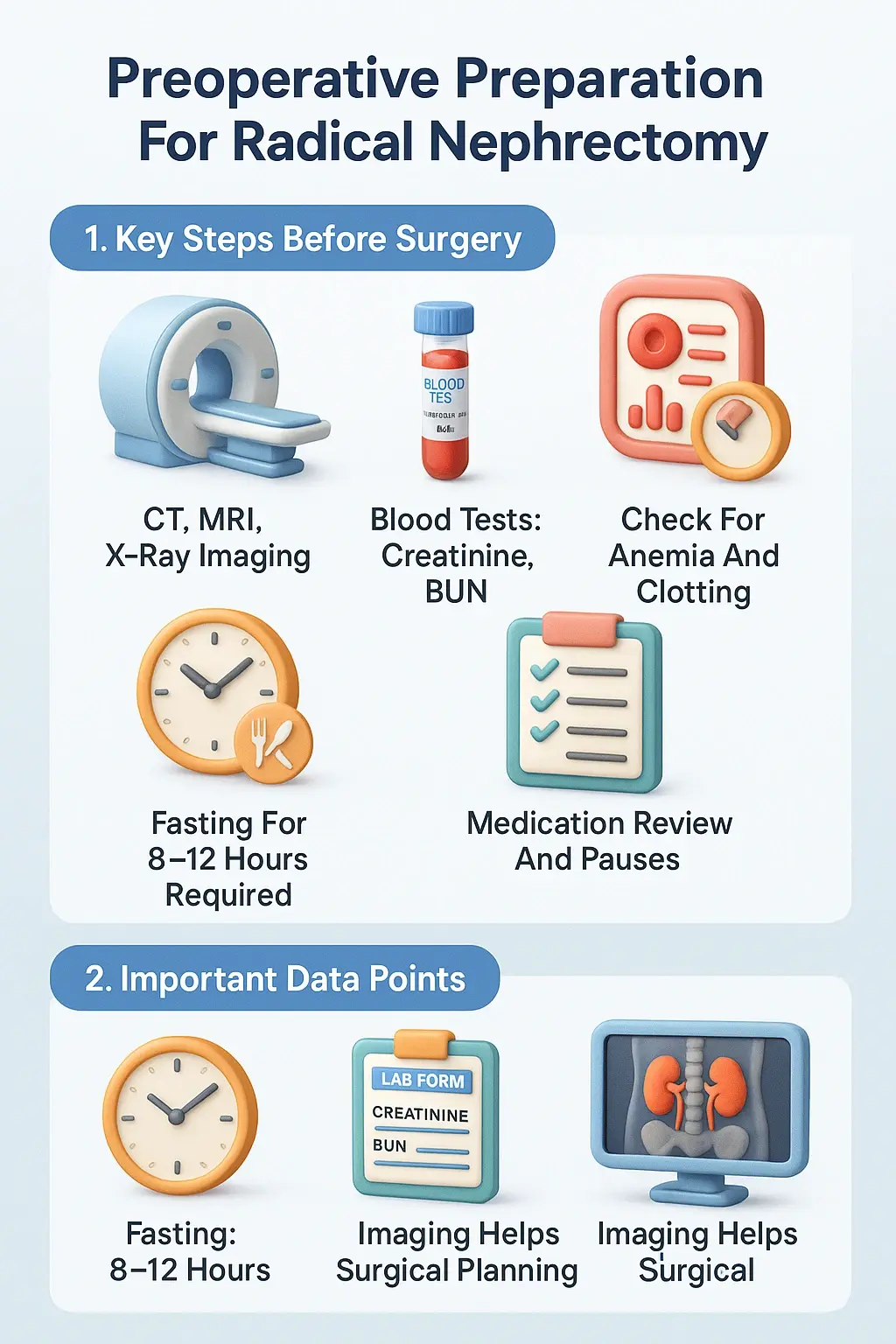
The surgeon needs a map before they start driving. You will undergo:
⦿ CT Scan (Computed Tomography): This gives a 3D view of the tumor.
⦿ MRI: This helps see if the tumor has grown into the veins.
⦿ Chest X-Ray: To make sure the lungs are clear of disease.
These images help the surgeon decide the best radical nephrectomy position for you on the operating table (usually lying on your side with a bolster under your ribs to open up the space).
⦿ Fasting: You must not eat or drink anything for 8 to 12 hours before surgery.
⦿ Medications: If you take blood thinners (like Aspirin, Clopidogrel, or Warfarin), you must stop them 5 to 7 days before. This prevents heavy bleeding.
⦿ Bowel Prep: Sometimes, you are given a laxative to clear your stomach so the bowel is flat and out of the way during surgery.
There are also radical nephrectomy anesthesia considerations. The anesthesiologist will check your heart and lungs to ensure you can sleep safely during the operation. If you smoke, you must stop at least 2 weeks before surgery to help your lungs recover.
While the surgeon works, a whole team watches you.
⦿ Vitals: Machines beep to show your heart rate and blood pressure.
⦿ Fluid Balance: Doctors give you IV fluids to keep your blood pressure stable since you are losing blood and a kidney.
⦿ Pneumatic Boots: Special squeezing cuffs are put on your legs to massage them during surgery. This prevents blood clots from forming in your legs.
You will wake up in a recovery room and then move to a ward.
⦿ Pain: You will have pain at the incision site. This is normal. You will get painkillers through your IV drip or an epidural (a tiny tube in your back).
⦿ Drains: You might have a small tube coming out of your side to drain extra fluid/blood from the empty kidney space. This is usually removed after 1 or 2 days.
⦿ Walking: The nurses will make you sit up and walk a few steps on the very first day after surgery. This is crucial to prevent pneumonia and clots.
⦿ Diet: You start with sips of water. Once you pass gas (showing your bowel is waking up), you can eat soft foods like khichdi, soup, or yogurt.
⦿ Activity: You should not lift anything heavier than 5kg for 6 weeks. This prevents a hernia. You can walk, climb stairs slowly, and do light household work. Driving is usually allowed after 4 weeks when you can press the brake without pain.
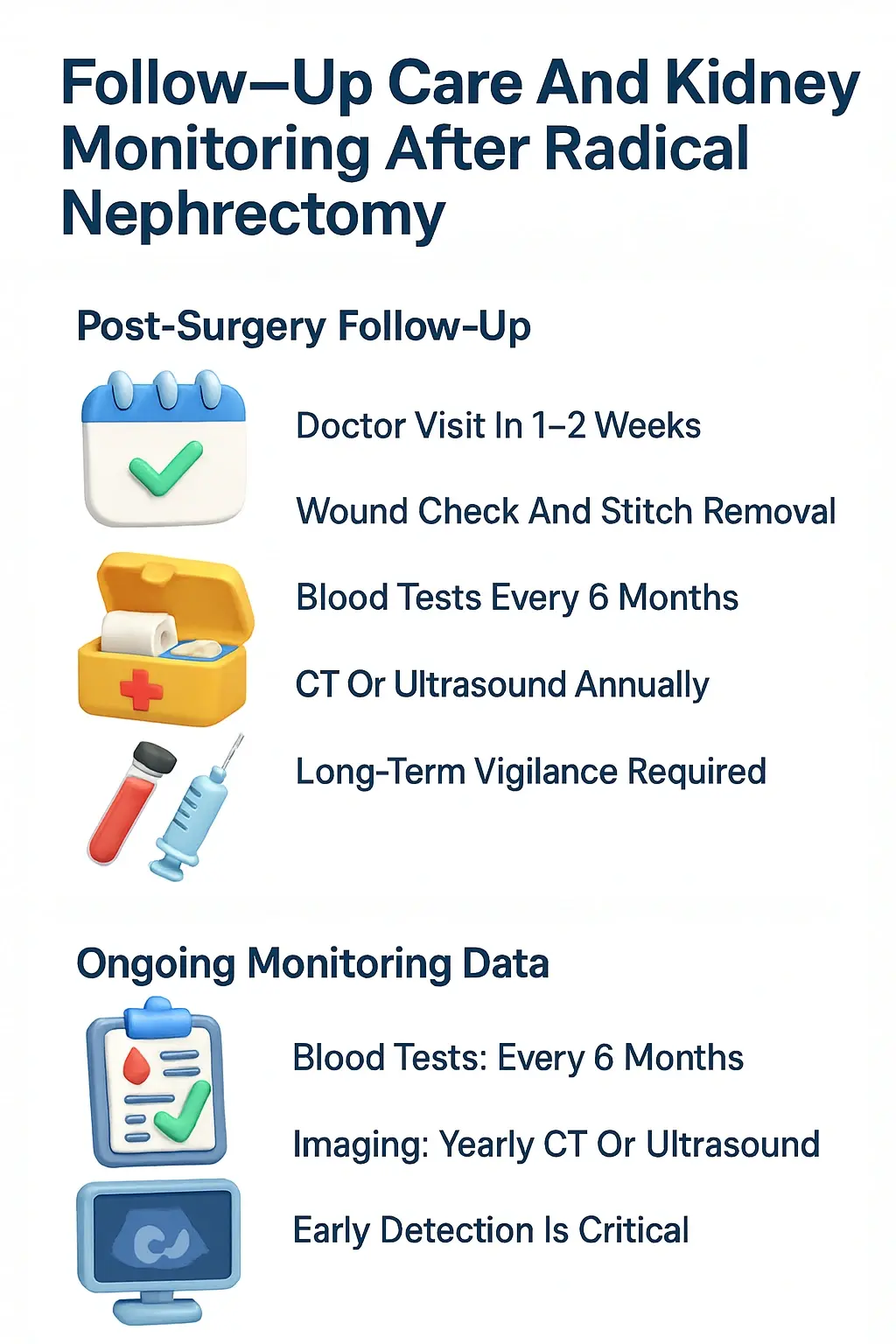
| Phase | Time Period | What to Expect |
|---|---|---|
| Hospital Stay | Day 1 to Day 5 | Pain management, removal of catheter, starting to walk. |
| Early Home Recovery | Week 1 to Week 3 | Feeling tired, incision soreness, needing rest after small tasks. |
| Getting Stronger | Week 4 to Week 6 | Energy returns, pain is gone, driving can resume. |
| Full Recovery | 3 Months+ | Internal healing complete, return to sports and heavy lifting. |
You must treat your remaining kidney like gold.
⦿ Stay Hydrated: Drink 2-3 liters of water daily (unless your doctor says otherwise).
⦿ Watch the Salt: Too much salt raises blood pressure, which hurts the kidney. Eat fresh food, not packaged chips or pickles.
⦿ Avoid NSAIDs: Common painkillers like Ibuprofen, Diclofenac, and Combiflam can damage the kidney. Always use Paracetamol for simple pain or ask a doctor.
⦿ Control Blood Sugar: Diabetes is the #1 enemy of kidneys. If you are diabetic, keep your sugar under strict control.
You need to watch for danger signs. If you experience radical nephrectomy symptoms of complications, act fast.
⦿ Fever over 101°F.
⦿ Redness, heat, or pus coming from the radical nephrectomy scar.
⦿ Severe pain that medicine does not help.
⦿ Sudden shortness of breath (could be a clot in the lung).
⦿ Inability to pass urine.
| Food Category | Foods to Eat (Good) | Foods to Avoid/Limit (Caution) |
|---|---|---|
| Proteins | Egg whites, fish, chicken, dal (in moderation). | Red meat (mutton/beef), processed sausages, high protein supplements. |
| Fruits/Veg | Apples, berries, cabbage, cauliflower, peppers. | Starfruit (toxic to kidneys), canned vegetables (high salt). |
| Drinks | Plain water, fresh lemon water, unsweetened tea. | Sodas (colas), sugary juices, excessive alcohol. |
| Seasoning | Herbs, garlic, onion, lemon juice. | Table salt, soy sauce, salty pickles/achar. |

Dr. Swati Shah is a renowned Robotic Uro and Gynecological Cancer Surgeon from Ahmedabad. He has 15+ years of extensive experience in pelvic oncosurgery and 10+ years of experience in robotic surgery. She treats cancers of kidney, bladder, prostate, uterus, ovaries and other pelvic organs.
Dr Swati Shah writes on recovery after surgery, which symptoms need a scan, and the questions patients actually ask in OPD. No advertising.
Your number is used for this letter and for the clinic to reach you. It is never sold or passed on. To stop, reply STOP on WhatsApp.