
... WhatsApp

New Scan-Based Risk Groups Help Predict Prostate Cancer Survival Better

You are here >> Home > Latest Updates > Prostate Cancer > New Scan…

New prostate cancer risk groups by PSMA-PET (PPP3) an international, retrospective, registry-based cohort study.DOI 10.1016S1470-2045(26)00016-1

Prostate cancer does not behave the same in every man. Some cancers grow slowly. Others spread faster. Doctors use risk groups to decide the best treatment and follow-up plan.

A new study looked at a modern scan called PSMA-PET. This scan can find prostate cancer more clearly than older imaging methods. Researchers wanted to see if this scan could improve how doctors predict survival.

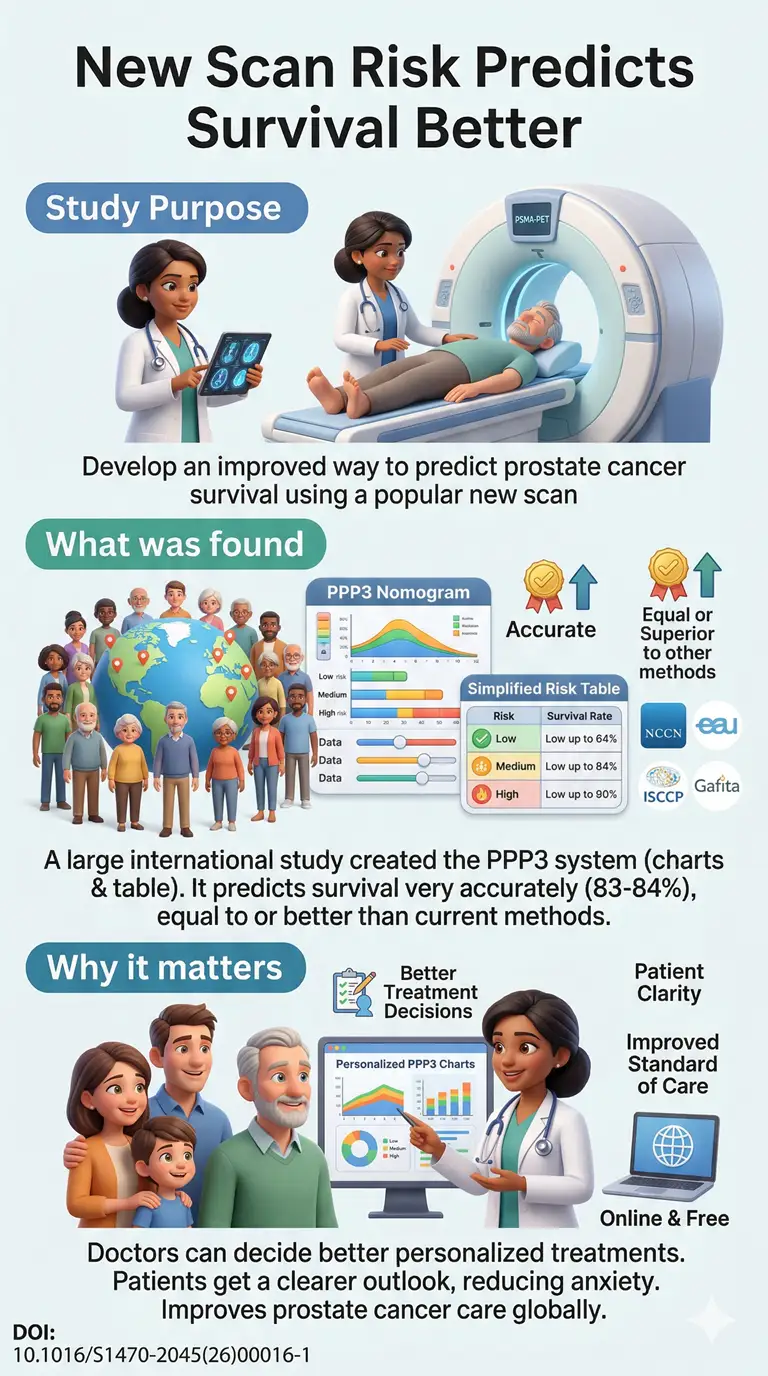
The study included over 11,000 men from many countries. All had prostate cancer and underwent PSMA-PET scans. Using this data, researchers created new risk groups called PPP3.

These new groups help predict how long patients may live at 3, 5, and 7 years. The results showed that this new system works better than older methods. It gives a more accurate picture of the disease.

What makes this important?

The PSMA-PET scan can show where the cancer is in the body with high detail. When this information is used to classify risk, doctors can make better decisions.

For patients, this means more personalized care. Some men may avoid unnecessary aggressive treatment. Others who need stronger treatment can be identified earlier.

The study also created a simple table that doctors can use in daily practice. This makes it easier to apply these findings in real clinics.

What does this mean for you?

If you have prostate cancer, advanced imaging like PSMA-PET may help your doctor understand your condition better. It can guide treatment choices and give a clearer idea of what to expect.

Ask your doctor if this type of scan is suitable for you. Better risk prediction can lead to better care and peace of mind.

This research brings a step forward in making prostate cancer treatment more precise and patient-focused.

Rate this post
dr swati shah - uro & gynec cancer surgeon
Privacy Overview

This website uses cookies so that we can provide you with the best user experience possible. Cookie information is stored in your browser and performs functions such as recognising you when you return to our website and helping our team to understand which sections of the website you find most interesting and useful.