WhatsApp
Best_kidney_cancer_doctor_in_Ahmedabad

Case Library - Kidney Cancer

Kidney Stones Sometimes Reveal a Hidden Kidney Cancer

1 2

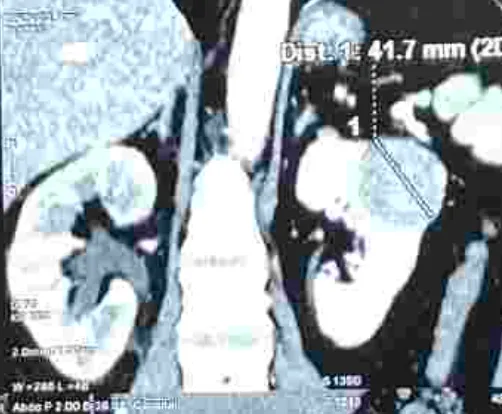
⦿ A 56-year-old gentleman came with right flank pain. Ultrasound showed a right upper ureteric stone, secondary right renal stones, and mild back pressure changes (hydronephrosis). During the same evaluation, another important finding was detected—a well-defined hyperechoic lesion in the left kidney. Further CT Renal Angiography demonstrated a well-defined rounded partially exophytic hypodense lesion with marked heterogeneous enhancement arising from the upper pole of the left kidney, suspicious for a malignant renal mass. There was no evidence of left renal vein or IVC thrombus, making the tumour suitable for nephron-sparing surgery.

⦿ Many kidney cancers are discovered incidentally while investigating kidney stones, urinary infections, or abdominal pain. This highlights why every renal mass detected on ultrasound should be evaluated carefully by a uro oncologist. Early diagnosis often allows kidney-preserving surgery (partial nephrectomy) instead of removing the entire kidney.

Bosniak Kidney Cyst or Kidney Cancer? CT Helps Differentiate the Two

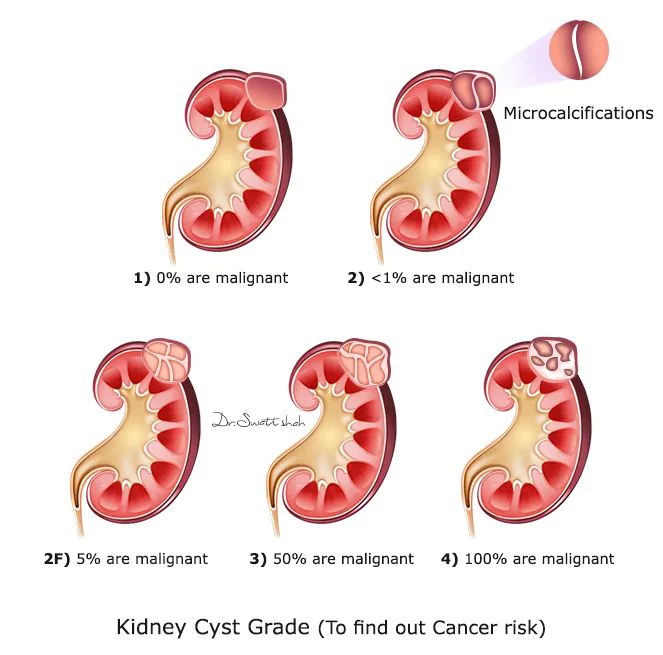
⦿ Ultrasound suggested a Bosniak Grade II haemorrhagic/proteinaceous cyst in the left kidney. While many Bosniak II cysts are benign, additional imaging is often required when associated findings raise concern. CT Renal Angiography in this patient demonstrated a heterogeneously enhancing partially exophytic renal mass, changing the diagnosis from a simple cystic lesion to a suspected renal tumour requiring surgery.

⦿ Patients frequently search for terms like Bosniak cyst, haemorrhagic kidney cyst, or proteinaceous renal cyst. Not every cyst is cancer, and not every renal mass requires complete kidney removal. Proper evaluation with contrast-enhanced CT or MRI, followed by review by an experienced kidney cancer surgeon, helps determine the correct treatment while preserving as much normal kidney as possible whenever feasible.

2 2

Robotic Partial Nephrectomy Preserves the Kidney While Removing the Cancer

3 3

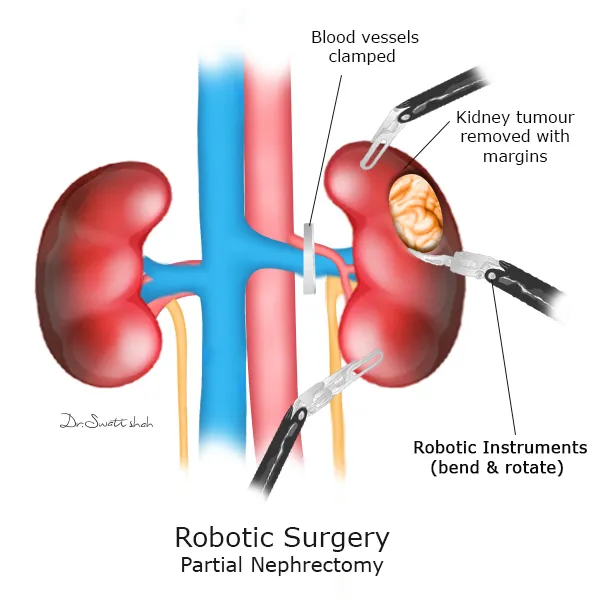
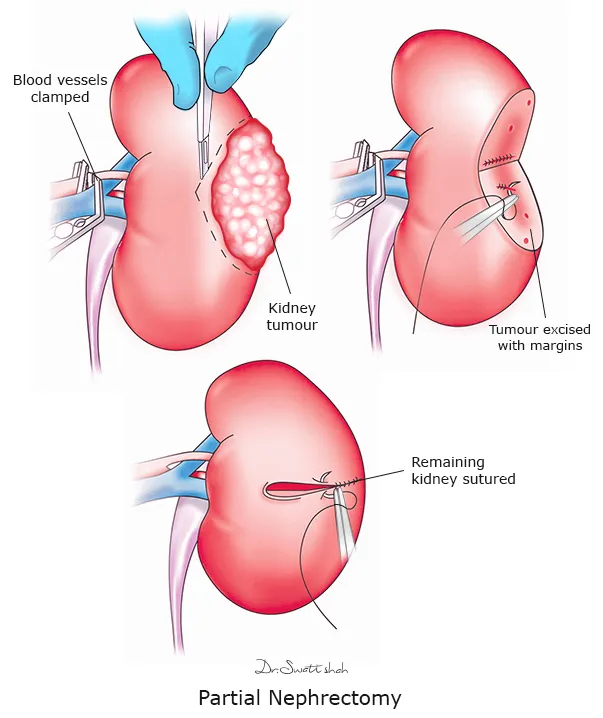
⦿ For this patient, the goal was not simply to remove the tumour—it was to preserve the kidney. Robotic surgery revealed an approximately 4 × 4 cm upper pole renal mass, inflammatory adhesions around the renal hilum, three renal arteries and one renal vein, making the operation technically demanding. The tumour was removed with a circumferential surgical margin, followed by meticulous renorrhaphy to reconstruct the kidney. Warm ischemia time was only 25 minutes, blood loss was approximately 200 ml, and no blood transfusion was required.

⦿ Modern robotic partial nephrectomy combines oncological safety with nephron preservation. Preserving functioning kidney tissue reduces the long-term risk of chronic kidney disease while achieving complete cancer removal whenever appropriate.

Kidney Cancer Surgery Can Be Planned Even When Kidney Stones Are Present

⦿ Many patients ask whether kidney cancer surgery can be performed if they also have kidney stones. In this patient, imaging showed right upper ureteric calculus, secondary right renal stones, previous retrograde intrarenal surgery (RIRS) with DJ stenting, along with a suspicious left renal mass. Despite multiple urological problems occurring together, careful planning allowed successful robotic partial nephrectomy for the kidney tumour while considering the overall urinary tract condition.

⦿ Patients with renal mass, ureteric stone, hydronephrosis, or Bosniak cyst should undergo comprehensive evaluation rather than treating only the stone. Management decisions often require coordination between imaging findings, kidney function, tumour characteristics, and surgical expertise. A multidisciplinary uro-oncology approach helps ensure that both cancer control and kidney preservation remain the priority.

The Final Diagnosis of a Kidney Tumour Comes from Histopathology—Not CT Scan Alone

⦿ A left renal mass was identified on imaging and treated with robotic partial nephrectomy. While CT strongly suggested renal cell carcinoma (RCC), the final diagnosis depended on the histopathology report.

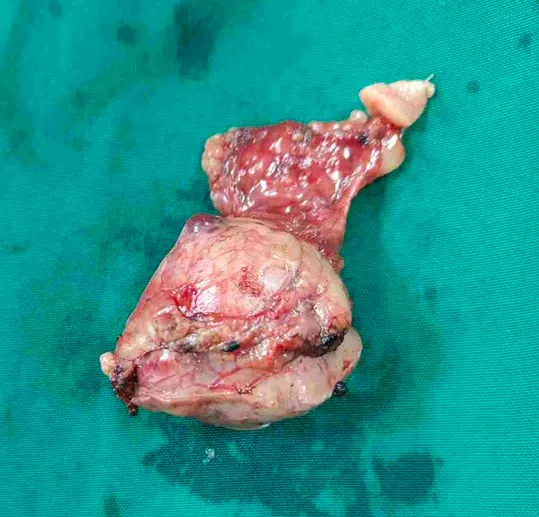
⦿ Histopathology showed a 5.5 × 4.5 × 4 cm tumour with renal cell carcinoma having eosinophilic cytoplasm. The morphology favoured Chromophobe Renal Cell Carcinoma (Chromophobe RCC) versus Oncocytoma, and Immunohistochemistry (IHC) was advised for further subtyping. The tumour was WHO/ISUP Grade 2, limited to the kidney, with pathological stage pT1b pNx.

⦿ Patients often search for renal mass, kidney tumour, Chromophobe RCC, Oncocytoma, or kidney cancer pathology. Imaging guides surgery, but the histopathology and IHC report provide the definitive diagnosis and help determine prognosis and further management.

Margin-Negative Kidney Cancer Surgery Is One of the Most Important Goals

⦿ In kidney cancer surgery, removing the tumour alone is not enough. The objective is to achieve complete tumour excision with negative surgical margins while preserving healthy kidney tissue whenever possible.

⦿ Histopathology in this patient confirmed that the renal parenchymal margin was free of tumour, perinephric fat was free of tumour, and the tumour remained limited to the kidney. There was no lymphovascular invasion, no tumour necrosis, no sarcomatoid features, and no rhabdoid features.

⦿ These pathological findings are important because they indicate complete surgical removal of the visible tumour. Patients searching for kidney cancer surgery, partial nephrectomy, renal cell carcinoma treatment, or kidney tumour surgeon should know that achieving negative margins is one of the key goals of cancer surgery.

6 3

Recovery After Robotic Partial Nephrectomy Is Usually Faster Than Open Surgery

7 1

⦿ Many patients worry more about recovery than the surgery itself. With robotic partial nephrectomy, recovery is often quicker because of smaller incisions, precise dissection and reduced blood loss.

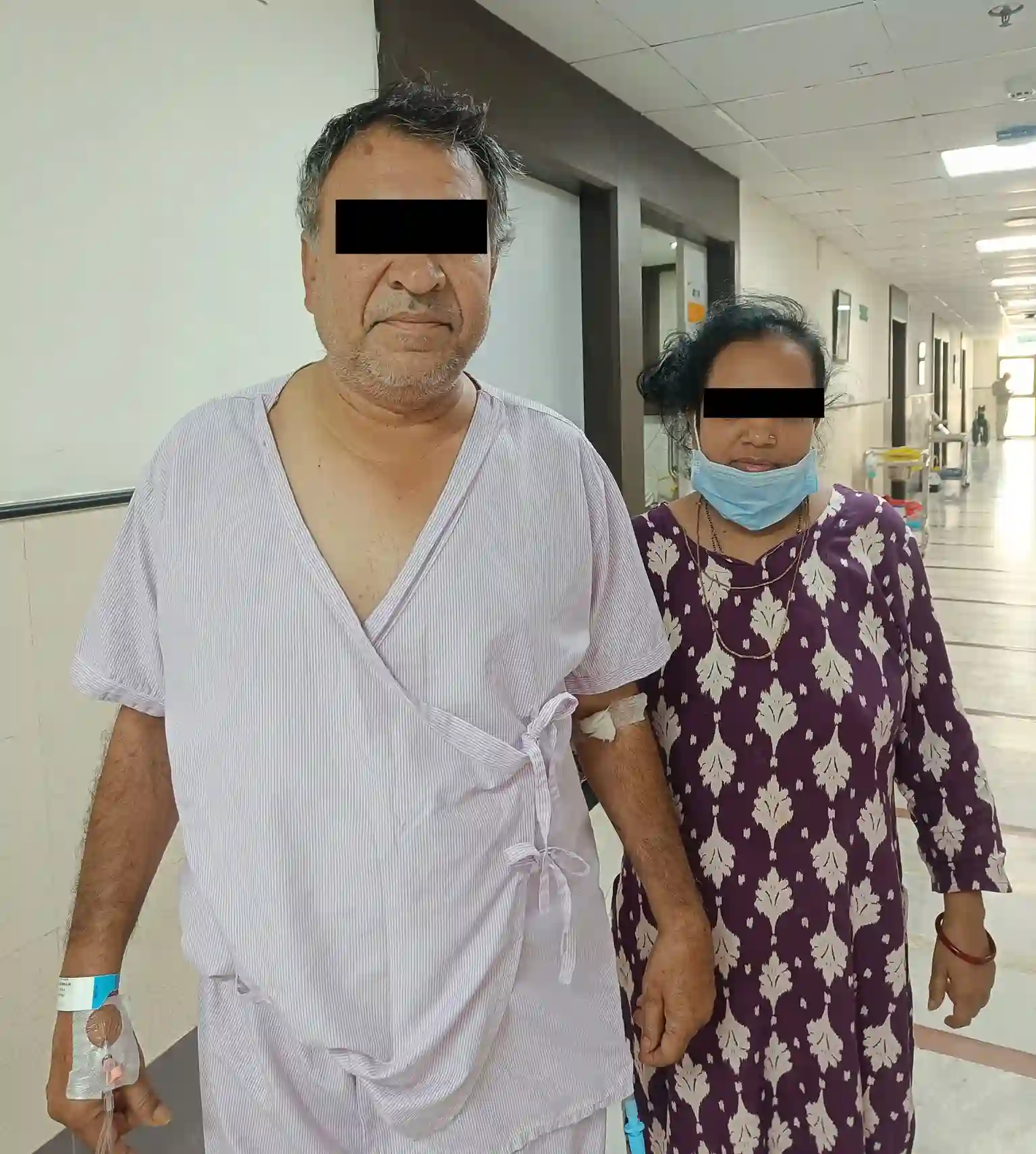
⦿ In this recently managed case, the patient underwent robotic nephron-sparing surgery with approximately 200 ml blood loss, no blood transfusion, and warm ischemia time of 25 minutes. Postoperatively, recovery was smooth with early mobilisation, gradual resumption of oral intake, drain management, and discharge after stable recovery.

⦿ Patients commonly search for recovery after kidney tumour surgery, robotic partial nephrectomy recovery, or hospital stay after kidney cancer surgery. Modern enhanced recovery protocols help many patients return to normal daily activities much earlier than expected.

Complex Kidney Surgery Requires Careful Planning of the Kidney Blood Vessels

⦿ Every kidney has a different blood supply. Before performing robotic partial nephrectomy, careful assessment of the renal arteries, renal vein, tumour location and relation to the collecting system is essential.

⦿ During this surgery, meticulous hilar dissection identified three separate renal arteries and one renal vein. Despite the complex vascular anatomy and inflammatory adhesions around the renal hilum, the renal tumour was removed completely with preservation of the remaining kidney. The kidney was reconstructed using renorrhaphy, while maintaining a warm ischemia time of 25 minutes.

⦿ Patients searching for complex kidney tumour surgery, robotic kidney cancer surgery, partial nephrectomy, renal artery anatomy, or kidney preservation surgery should understand that detailed vascular planning is one of the reasons why robotic surgery can safely manage technically challenging renal masses while preserving maximum kidney function.

8 1
Rate this page

Get free health updates from Dr Swati Shah on WhatsApp

Swasth Parivar: twice a month, practical advice on recovery, diet and warning signs. No advertising. Stop any time.

Your number is used for these updates and for the clinic to reach you. It is never sold or passed on. To stop, reply STOP on WhatsApp.

dr swati shah - uro & gynec cancer surgeon
Privacy Overview

This website uses cookies so that we can provide you with the best user experience possible. Cookie information is stored in your browser and performs functions such as recognising you when you return to our website and helping our team to understand which sections of the website you find most interesting and useful.