Dr Swati Shah · Apollo Hospital, Bhat, Gandhinagar · Gota OPD, Ahmedabad
Shah’s Gastro, Cancer & Robotic Surgery Centre — trained at national cancer centres, fully qualified in surgical oncology, and operating on urological cancers every week.

Dr Swati Shah
MS, DrNB (Surgical Oncology)
Testicular Cancer Surgeon · Apollo Hospital, Bhat, Gandhinagar · Gota OPD, Ahmedabad
Google: 4.99 from 85 reviews (Gota clinic) · 5.0 from 28 reviews (Apollo, Bhat)
This page is for a man who has been told he has a testicular tumour, or whose scan has just come back, and who wants to know what the operation will take from him and what can be kept. It is written by Dr Swati Shah around one question the standard consultation often leaves until too late: what happens to fertility, hormones and ejaculation.
Most men reach this point after a painless lump or a swelling that did not settle. A large number have already had one course of antibiotics for a presumed infection. If a scrotal swelling has not resolved after a single course, it needs a scan — not a second course. That delay is the commonest avoidable problem in this disease in India, and it is the reason some men arrive with disease that has already moved into the abdomen.
The good news is worth saying plainly at the start. Testicular cancer is usually curable, including when it has spread, and the treatment is worth completing on schedule. The decisions on this page are therefore not about whether you will get through it. They are about what you will still have afterwards.
Sperm banking is offered to every patient at the first consultation, before any surgery or chemotherapy, and the answer is written into the record. It cannot be done once treatment has started, and no later decision can recover it.
This is the single instruction on this page that is not negotiable and not personal to any one man. It is offered to the man who says he has completed his family, to the unmarried man, and to the man who wants the operation done this week. The reason is simple: semen quality is often already reduced at the time of diagnosis, chemotherapy and abdominal lymph node surgery both threaten fertility further, and a sample is worth storing even when the count is poor.
Banking is done at a private andrology laboratory in Ahmedabad, it is self-funded, and it takes a few days to arrange. Dr Swati Shah raises it and the cost at the first consultation precisely so the family has those days — the offer is most often lost when it is mentioned on the morning chemotherapy is due to start. Cancer treatment is not delayed for it; in almost every case at least one sample can be obtained inside the treatment timetable. If banking genuinely cannot be done, the reason is written down.
The affected testis is removed through a small cut in the groin, with the cord controlled high at the internal ring — never through the scrotum. A trans-scrotal operation or a trans-scrotal biopsy changes where the cancer can spread and cannot be undone.
This operation is both the diagnosis and the first treatment. The testis is delivered through the groin incision, the cord is tied off high with a marking suture, and the specimen goes to pathology whole. The reason for the inguinal route is not surgical preference: the testis drains to lymph nodes at the back of the abdomen, and cutting into the scrotum opens a second drainage route that was never involved. That is why the same operation done through a scrotal incision in a non-specialist unit permanently alters staging, follow-up and sometimes the radiation or surgical field afterwards.
Tumour markers — AFP, beta-hCG and LDH — are taken before the operation and repeated after it. The post-operative values are what set the stage and the treatment group, and a missing pre-operative set cannot be recreated. If you are reading this before surgery anywhere, that blood test is the one thing to insist on.
A testicular prosthesis can be placed at the same sitting or later. Most men in India are never told it exists. Dr Swati Shah offers it explicitly and records the conversation, because silence about it is a counselling failure rather than a cost decision — it is self-funded, and the current cost is given to you at the consultation so you can decide rather than discover.
Retroperitoneal lymph node dissection, or RPLND, is the operation that clears the lymph nodes at the back of the abdomen. It is needed for a residual mass left after chemotherapy in non-seminoma, for a PET-positive residual mass in seminoma, and in selected cases as the primary treatment.
The nodes behind the abdomen are where testicular cancer travels first. After chemotherapy a mass may remain there, and the reason it is removed rather than watched is that a substantial share of these masses contain teratoma, which chemotherapy does not kill and which can grow or change over years. Removing it is the treatment; there is no drug alternative.
RPLND is major abdominal surgery, not a staging procedure, and it is not the same operation before and after chemotherapy. In a previously treated abdomen the tissue around the great vessels is scarred and fixed, and the operation may need vascular repair, occasionally removal of a kidney, and always an experienced team. Dr Swati Shah performs RPLND by open, laparoscopic and robotic routes; which one is used depends on the mass, not on preference, and complete clearance takes precedence over every other consideration.
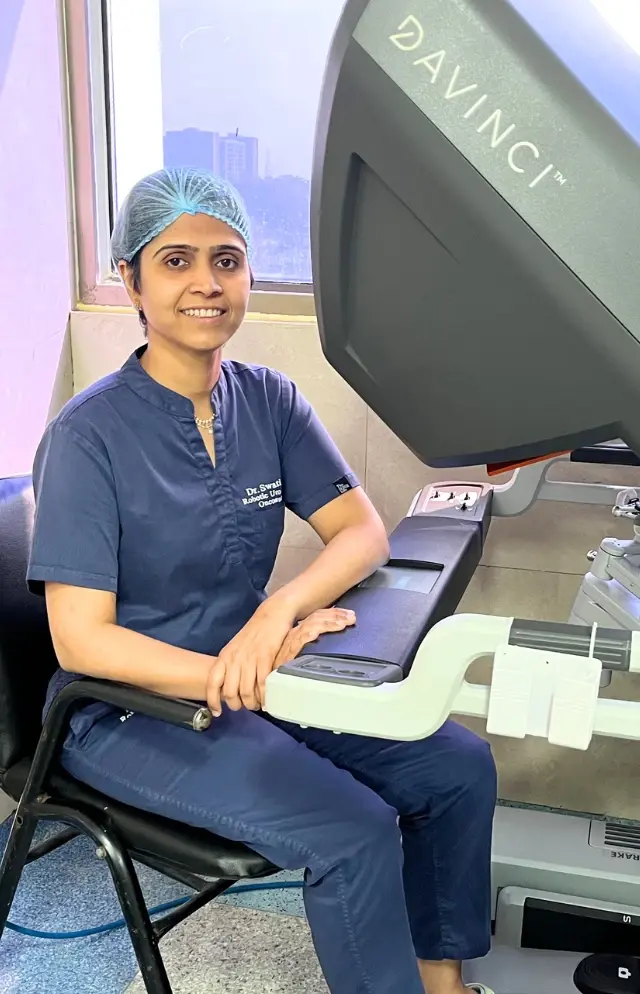
Dr Swati Shah at the console. A robotic RPLND is offered where the mass allows it; a scarred post-chemotherapy retroperitoneum is often better served by an open operation, and that call is made on the scan, not on the equipment available.
The nerves that produce forward ejaculation run across the same area RPLND clears. Nerve-sparing technique is attempted in every case where the cancer allows it; where it cannot be done, ejaculation is permanently dry and natural conception is no longer possible without assisted reproduction.
This is the conversation this page exists for, and it belongs before the operation rather than at the follow-up visit. The sympathetic fibres that close the bladder neck and drive semen forward cross the retroperitoneum in the field being cleared. When they are identified and preserved, forward ejaculation is usually kept. When the disease sits on them — which is common after chemotherapy, in a desmoplastic field, or with a large mass — they cannot be preserved and the loss is permanent.
Two things follow, and Dr Swati Shah says both of them out loud before surgery. First, erection and orgasm are not lost; what is lost is semen coming forward, which is why the term used is dry orgasm. Second, if the nerves cannot be spared, fertility afterwards depends on whether sperm was banked — which is why §1 of this page is about banking and not about the operation.
Where it is oncologically safe, a template is used that keeps the operation off the nerve pathways. Where the mass dictates a bilateral clearance, the mass wins. You are told which of the two happened, in person, before you go home — not in the discharge summary.
One remaining testis usually produces enough testosterone and enough sperm for normal life and often for natural conception, but not always. Testosterone is checked at one year and periodically after that, and a low level is treatable.
Men worry about three separate things here and it helps to separate them. Hormone: the remaining testis usually takes over, and where it does not, replacement is straightforward and lifelong. Fertility: one testis is often enough, but chemotherapy and RPLND each reduce the margin, which is the reason banking is not optional. Appearance and sensation: the scrotum looks and feels different after one testis is removed, and a prosthesis is the answer for a man who wants one.
Beyond hormones there is a survivorship tail that specialist follow-up is designed to catch — metabolic and cardiovascular risk, hearing changes after cisplatin, and the small but real chance of a tumour in the other testis. Monthly self-examination of the remaining testis is taught at discharge and is genuinely the most useful thing a survivor does.
An orchidectomy is a day-case or overnight operation with most men back to desk work inside two weeks. An RPLND is major abdominal surgery with a hospital stay of several days and a graded return over six to eight weeks.
| Stage | After orchidectomy | After RPLND |
|---|---|---|
| Day 0 | Sitting out and eating the same evening; scrotal support and ice; oral painkillers | Sitting out the same evening; sips of water; epidural or block-based pain control |
| Day 1–3 | Usually home on day 1; wound and scrotal check; histology date given | Diet stepped up; walking three times a day; breathing exercises hourly; drains watched as feeding restarts |
| Discharge | Day 1, on oral painkillers | Typically day 4–7, once eating, walking and pain-controlled |
| Desk work | About 1–2 weeks | About 4–6 weeks |
| Heavy work, gym, driving long distance | About 4 weeks | About 8 weeks, reviewed at follow-up |
| Fertility review | At the first follow-up, with the banking record | At the first follow-up, with the ejaculation result stated in person |
If bleomycin has been given as part of chemotherapy, the anaesthetist is told in writing and keeps oxygen deliberately low during and after surgery, and fluids tight. That is not caution for its own sake — high oxygen is what precipitates lung injury in a man who has had bleomycin, and it is one of the reasons this operation belongs in a unit that does it regularly.
Every case is discussed in a multidisciplinary meeting after the testis is removed and before anything else is started, including every stage I patient where the real choice is surveillance versus treatment.
| Situation | What is usually chosen | What decides it |
|---|---|---|
| Disease confined to the testis, markers normal | Surveillance after orchidectomy, for most men | Whether you can attend the follow-up schedule reliably; tumour size and rete testis invasion in seminoma; lymphovascular invasion in non-seminoma |
| Limited nodes in the abdomen | Chemotherapy, or in selected seminoma a nerve-sparing node dissection | Node size, marker status and whether the aim is to avoid chemotherapy altogether |
| Larger nodes or spread beyond | Cisplatin-based chemotherapy first, surgery afterwards if a mass remains | Prognostic group, marker levels, and the response on the post-treatment scan |
| Residual mass after chemotherapy | RPLND in non-seminoma; observation in seminoma unless the mass is large and PET-positive | Size of the mass, marker normalisation, and the interval since the last cycle |
| A mass appearing years later | Surgery | Late teratoma does not respond to drugs — it is removed |
Surveillance is a treatment, not an absence of one, and it only works if you attend. Dr Swati Shah discusses this honestly with men who live far from Ahmedabad or whose work makes a three-monthly schedule unrealistic, because a schedule set up to fail is worse than a single dose of preventive chemotherapy openly chosen.
★★★★★
“I underwent RPLND surgery under the expert care of Dr. Swati Shah. The entire treatment process was handled with great precision and care. She is highly skilled in managing complex cancers, including testicular cancer, using advanced surgical techniques. I am very thankful for her support and dedication. She is truly one of the best surgeons for testicular cancer. Highly recommended.”
Dharmesh Chahan — Google review, Apollo Hospital, Bhat
★★★★★
“My had a testicular tumour treated with Radical Orchidectomy. Excellent uro cancer surgeon in Ahmedabad.”
Dharmesh Chahan — Google review, Gota clinic
These are unedited Google reviews from men treated for testicular cancer, taken from Dr Swati Shah’s own two listings.
Reviews are reproduced exactly as written, including spelling and spacing.
A patient who was treated for testicular cancer tells his own story:
Dr Swati Shah explains how testicular cancer is treated:
From the first call to full recovery, the pathway runs consultation, tests and plan, surgery, a short stay, then follow-up — with the fertility decision taken at step one, not step three.
Testicular cancer surgery at Apollo Hospital, Bhat is covered by most health insurance policies and is handled cashless where the policy allows. Sperm banking and a testicular prosthesis are usually self-funded and are quoted to you separately at the consultation.
What moves an estimate is the operation itself, not the diagnosis: an orchidectomy is a short, low-intensity admission, while an RPLND is major surgery with a longer stay, and a post-chemotherapy RPLND with vascular involvement sits higher again. Room category, how long you stay and whether intensive care is needed after a large clearance are the other variables.
For cashless treatment the hospital’s insurance desk raises pre-authorisation once the plan is fixed; bring the policy card, photo identity, and previous treatment records. Dr Swati Shah’s coordinator will tell you which documents the insurer is currently asking for, since that list changes. Reimbursement is also possible where the policy has no cashless tie-up. Ask for the estimate in writing before admission — it is given as a matter of course.
Often yes — one healthy testis usually produces enough sperm. But chemotherapy and abdominal node surgery both reduce that margin, which is why sperm is banked first rather than hoped for afterwards.
It means orgasm and erection are normal but semen does not come forward. It happens when the nerves crossing the abdomen cannot be spared during RPLND, and where it happens it is permanent.
No. A residual mass after chemotherapy is removed because it may contain teratoma, and teratoma does not respond to chemotherapy however many cycles are given.
For many men with disease confined to the testis, yes — surveillance is the preferred route. It depends on attending every scheduled visit and scan, and that is discussed honestly before it is chosen.
A testicular prosthesis can be placed at the time of the operation or later, and most men are never told this is available. Ask for it if you want it.
Not by itself. The operation on the testis is an open groin operation in every case. For abdominal node clearance the route — open, laparoscopic or robotic — is chosen from the scan, and complete removal of the mass matters more than the instrument used.
Shah’s Gastro, Cancer & Robotic Surgery Centre
SF-203 (Second Floor), Olive Greens, Sarkhej – Gandhinagar Hwy, Gota, Ahmedabad, Gujarat, India 382481
Open in Maps
Apollo Hospital International Limited
Plot No. 1 A, Apollo Hospital International Limited, GIDC Bhat, Industrial Estate, Gandhinagar, Gujarat 382428
Open in Maps
Consultations are at the Gota clinic in Ahmedabad and surgery is at Apollo Hospital International Limited, Bhat, Gandhinagar.
Men travel to Ahmedabad for this from across Gujarat and from Rajasthan and Madhya Pradesh. If you are coming from outside the city, send the reports ahead on WhatsApp so the first visit can be a decision rather than a triage.
Testicular cancer is one of the most curable cancers there is. The part that is easy to lose is fertility — and it can only be protected before treatment starts, never after. Call +91 63590 11009 WhatsApp Dr Swati Shah's team
Swasth Parivar: twice a month, practical advice on recovery, diet and warning signs. No advertising. Stop any time.
Your number is used for these updates and for the clinic to reach you. It is never sold or passed on. To stop, reply STOP on WhatsApp.