
When prostate cancer spreads beyond the prostate, one of the first places it may reach is the pelvic lymph nodes.
During radical prostatectomy, pelvic lymph-node dissection (PLND) may therefore be performed in appropriately selected patients.
The purpose is primarily to determine:
Modern imaging, including PSMA PET/CT, has improved the detection of lymph-node and distant disease. However, imaging cannot reliably identify every microscopic lymph-node metastasis. Pathological examination of removed lymph nodes can provide additional staging information.
Pelvic lymph-node dissection is the surgical removal of lymphatic tissue from specific regions of the pelvis.
During robotic radical prostatectomy, PLND can be performed through the same minimally invasive approach.
The removed lymphatic tissue is sent to an expert pathology laboratory, where the lymph nodes are examined for metastatic prostate cancer.
The final pathology may report:
A patient with no involved lymph nodes is classified as pN0.
When regional pelvic lymph-node metastases are identified, the pathological stage is pN1.
No.
The decision should be based on the estimated risk of lymph-node involvement and the overall treatment plan.
Important factors include:
For men at low risk of lymph-node involvement, PLND may provide little additional information while exposing the patient to additional surgical morbidity.
For patients with a higher probability of nodal disease, PLND may provide valuable pathological staging.
The exact threshold and extent of PLND should therefore be individualized rather than applied identically to every patient.
Modern imaging has significantly improved prostate cancer staging.
Multiparametric MRI is particularly valuable for assessing the prostate and local tumour extent.
However, conventional CT and MRI have limited sensitivity for microscopic lymph-node metastases.
PSMA PET/CT is more sensitive than conventional imaging for detecting many lymph-node and distant metastases and is increasingly important in staging higher-risk prostate cancer. Current EAU guidance recommends PSMA PET/CT where available for staging appropriate unfavourable intermediate-risk and high-risk/locally advanced disease.
However:
A negative PSMA PET/CT does not necessarily mean that every pelvic lymph node is free of microscopic cancer.
Small-volume nodal metastases may remain below the resolution or detection threshold of imaging.
Therefore, in appropriately selected patients undergoing radical prostatectomy, pathological lymph-node assessment can still provide additional information.
The term PLND describes a range of possible anatomical dissections.
The exact boundaries vary somewhat between published definitions and guidelines.
An extended pelvic lymph-node dissection (ePLND) generally includes lymphatic tissue around:
The current EAU description of ePLND includes nodes overlying the external iliac artery and vein, nodes within the obturator fossa around the obturator nerve, and nodes medial and lateral to the internal iliac artery.
The more extensive the dissection, the greater the potential lymph-node yield — but also the greater the potential for complications such as lymphocele.
Therefore, “more lymph nodes” does not automatically mean “better treatment.”
The appropriate template should be selected according to the patient’s risk and the purpose of the operation.
The strongest established role of PLND is pathological staging.
It can identify lymph-node metastases that were not detected on preoperative imaging.
This information can:
Current EAU guidance describes ePLND as a staging procedure that provides information useful for management and prognostication.
This is an important question — and patients should receive an honest answer.
Not necessarily.
Although extended PLND removes more lymphatic tissue and detects more positive nodes, randomized trials have not demonstrated a consistent oncological benefit from simply performing a more extensive dissection compared with a limited dissection.
The current EAU guideline notes that randomized trials have not shown a clear improvement in biochemical recurrence outcomes with ePLND, and the overall survival benefit remains unproven.
Therefore:
The objective of PLND is not simply to remove as many lymph nodes as possible.
It is to obtain appropriate pathological staging while balancing the potential benefit against surgical morbidity.
When PLND is performed with RARP, it can usually be carried out through the same robotic access.
The operation involves careful identification and dissection of the relevant pelvic anatomical boundaries.
Important structures include:
The lymphatic tissue is carefully separated and removed while protecting important nerves, vessels and adjacent structures.
The specimen is then submitted for pathological examination.
PLND is not simply about removing fatty tissue containing lymph nodes.
The pelvic lymphatic tissue lies around important structures.
A meticulous dissection is required to reduce the risk of injury to:
This is particularly important in patients with:
The ability to perform complex pelvic dissection is therefore an important component of advanced robotic pelvic oncology surgery.
If prostate cancer is identified in the pelvic lymph nodes, the patient is classified as pathological node-positive (pN1) disease. This does not automatically mean that the cancer is incurable.
The significance depends on the overall disease profile, including:
Patients with pN1 disease may require additional treatment or closer surveillance.
Management should therefore be individualized through multidisciplinary discussion.
Read more → Locally Advanced & Node-Positive Prostate Cancer: Where Does Surgery Fit?
If all examined lymph nodes are negative for cancer, the patient is classified as pN0.
This provides valuable pathological staging information.
However, a negative PLND does not mean that recurrence is impossible.
The risk of recurrence is determined by the complete pathological and clinical picture, including:
PLND is therefore one component of prostate cancer staging, not the sole determinant of prognosis.
PLND adds surgical dissection to the prostatectomy and therefore can increase morbidity.
Potential complications include:
A collection of lymphatic fluid within the pelvis.
Some lymphoceles are asymptomatic, while others can cause pain, infection, compression of pelvic structures or require drainage.
Pelvic blood vessels are carefully dissected and protected, but bleeding remains a potential complication.
The external and internal iliac vessels and their branches lie within the dissection field.
The obturator and genitofemoral nerves are among the important structures that require protection.
Lymphatic disruption can contribute to lower-limb or genital lymphoedema, particularly when extensive nodal surgery is combined with pelvic radiation.
The risk of lymphocele increases with greater extent of PLND. Current EAU guidance reports symptomatic lymphocele rates varying across contemporary studies and notes increased morbidity with more extensive dissection.
Good pelvic lymph-node surgery involves not only removing the appropriate lymphatic tissue but also reducing avoidable complications.
Important principles include:
Various techniques, including peritoneal interposition flaps, have been studied to reduce lymphocele formation. Evidence remains mixed, so the technique should be selected according to the surgical setting and individual patient.
There is no single template that should be applied to every prostate cancer patient.
The decision considers:
Dr Swati Shah has specific training in pelvic lymph-node dissection as part of robotic prostate cancer surgery.
PLND forms a major component of her prostatectomy practice.
In her analysed surgical series:
~95% of radical prostatectomy cases underwent pelvic lymph-node dissection.*
The average number of lymph nodes retrieved was approximately:
15 lymph nodes per dissection
The actual decision to perform PLND and the extent of dissection are individualized according to the patient’s cancer risk and treatment plan.
These are surgeon-maintained clinical data from an analysed surgical series. The figures should be interpreted in the context of the cohort, inclusion criteria and surgical indications.
The pelvic lymph nodes lie in a technically demanding anatomical region.
A surgeon performing prostate cancer surgery should understand not only prostate anatomy but also:
Dr Swati Shah’s training and practice have included robotic prostatectomy, pelvic lymph-node dissection, locally advanced prostate cancer and complex/reoperative pelvic cancer surgery.
Her experience therefore extends beyond the use of a robotic platform to complex pelvic oncological dissection.
Patients with high-risk or locally advanced prostate cancer require particularly careful staging.
Current EAU guidance recommends metastatic staging with PSMA PET/CT where available for high-risk/locally advanced disease.
In selected patients undergoing radical prostatectomy, pelvic lymph-node dissection may form part of the surgical and staging strategy.
However, high-risk disease should not be approached as:
“Do a prostatectomy and remove the lymph nodes.”
Instead, the treatment plan should consider:
Primary tumour + lymph nodes + distant disease + pathology + systemic treatment + radiation options
This is why multidisciplinary planning is important.
Read more → Locally Advanced & Node-Positive Prostate Cancer: Where Does Surgery Fit?
When lymph-node involvement is suspected or identified, treatment may require input from:
Dr Swati Shah’s prostate cancer cases are discussed within a multidisciplinary framework when appropriate.
This is particularly important for:
The aim is to decide not only whether lymph nodes should be removed, but also what their findings mean for the patient’s subsequent treatment.
Our prostate cancer case library contains real cases in which pelvic lymph-node dissection formed part of treatment.
Representative situations include:
[FEATURED PLND CASE] → View the complete case summary → View all Prostate Cancer Case Summaries
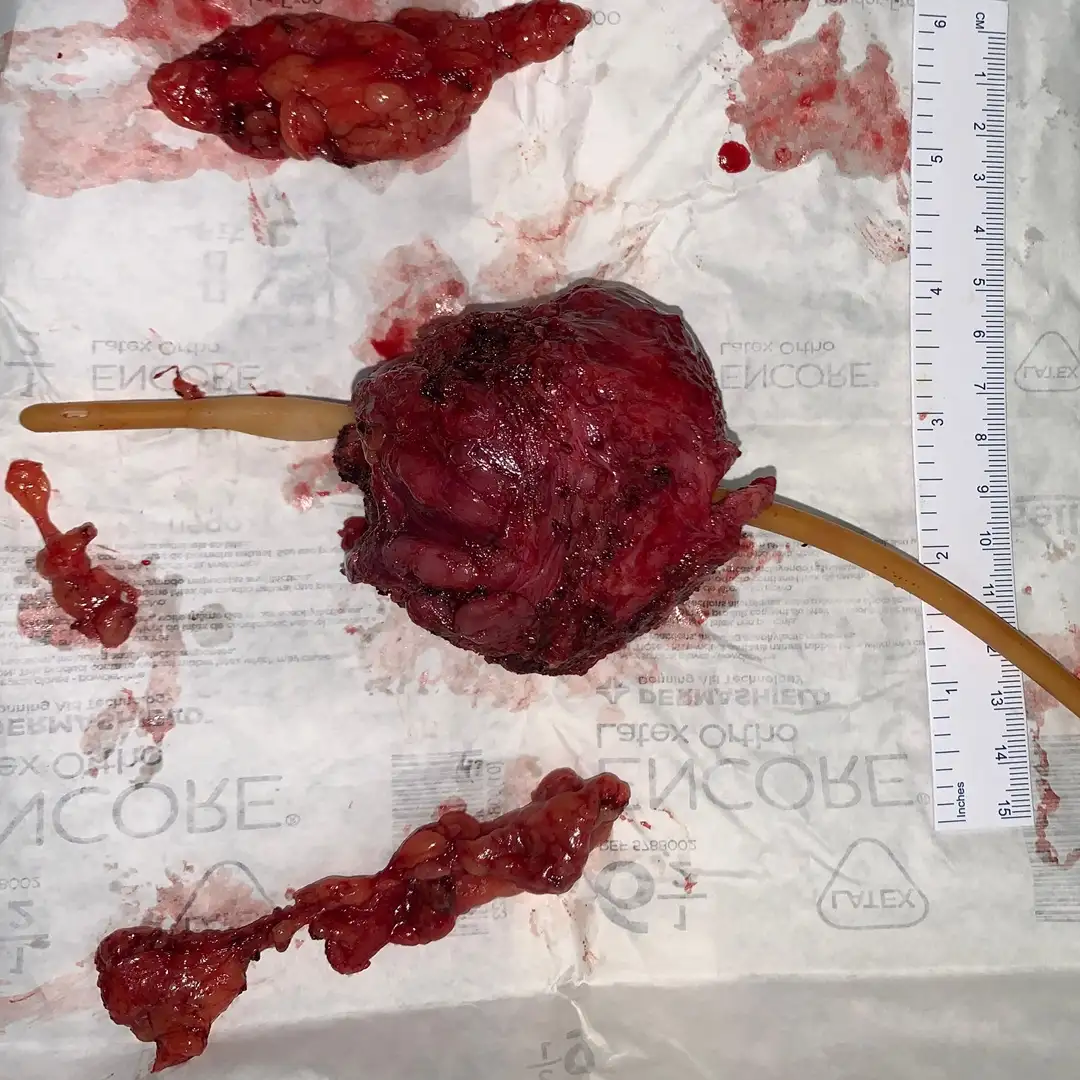
A 67-year-old male presented with urinary urgency and a significantly elevated PSA level of 144.92 ng/ml. Diagnostic imaging and biopsy confirmed an acinar adenocarcinoma, demanding an urgent and highly precise surgical intervention to prevent potential systemic spread while managing the high biochemical risk.
⦿ Robotic-Assisted Radical Prostatectomy and Lymphadenectomy
• Procedure: A minimally invasive radical prostatectomy was executed with unilateral neurovascular bundle preservation.
• Lymph Nodes: A total of 20 pelvic lymph nodes were successfully removed and staged.
• Safety: The surgery was completed with a very low blood loss of 150 ml.
• Cancer Clearance: Pathological examination confirmed negative surgical margins, indicating the complete removal of the tumor.
⦿ Full Oncological Clearance and Early Mobilization
The patient’s postoperative recovery was excellent, characterized by early mobilization and a stable discharge within a few days. Final histopathology confirmed a pT2N0 stage with zero lymph node involvement and no extraprostatic extension. Crucially, the patient achieved early urinary continence, returning to his routine daily activities without significant functional impairment or complications.
By utilizing robotic precision, we achieved complete cancer clearance despite the patient's high pre-operative PSA levels. This approach allowed for meticulous nerve preservation and reconstruction, which are vital for maintaining the patient's quality of life and ensuring a rapid return to normalcy.
Surgical Image
[FEATURED OPERATIVE IMAGE — PELVIC LYMPH-NODE DISSECTION] → View Prostate Cancer Surgical Gallery
Patient Education Video
Understand prostate cancer, robotic prostatectomy and recovery through patient-focused educational videos.
[FEATURED EDUCATIONAL VIDEO] → Watch Prostate Cancer Education Videos
No. PLND is performed selectively according to the patient’s risk of lymph-node involvement and the overall treatment plan.
A negative PSMA PET/CT reduces the likelihood of detectable nodal disease but does not exclude all microscopic metastases. The decision depends on the overall risk profile and treatment plan.
There is no single number that defines an adequate PLND for every patient. The anatomical template and quality of dissection are more meaningful than pursuing a particular numerical target.
Extended PLND identifies more lymph nodes and can improve pathological staging, but greater extent also increases morbidity. Randomized evidence has not established a consistent survival or biochemical-recurrence benefit simply from performing a more extensive dissection.
No. PLND is performed because there is a sufficient risk of nodal disease to justify pathological assessment. Many patients undergoing PLND have negative nodes.
pN1 means that prostate cancer has been identified in regional lymph nodes on pathological examination. It does not by itself determine the entire prognosis or subsequent treatment.
Yes. Selected patients with regional node-positive disease may undergo multimodal treatment. The appropriate strategy depends on the extent of nodal disease, primary tumour features, PSA and other factors.
Lymphocele is an important lymph-node-dissection-related complication. Most are not clinically significant, but some may require drainage or other treatment.
No. A more extensive dissection increases the opportunity to detect nodal disease but also increases surgical morbidity. More extensive PLND should therefore be performed selectively rather than simply because a higher node count is considered better.
The goal is not to remove the maximum number of lymph nodes.
The goal is to perform appropriate pathological staging with the appropriate anatomical dissection for the individual patient, while minimizing avoidable morbidity.
A thoughtful PLND decision integrates: PSA + Grade Group + Biopsy + MRI + PSMA PET/CT when indicated + Risk Classification + Clinical Stage + Planned Treatment
The final decision should be part of the overall prostate cancer treatment plan.
[REQUEST A PROSTATE CANCER SECOND OPINION]
[BOOK A CONSULTATION WITH DR SWATI SHAH]
What Is Robotic Radical Prostatectomy (RARP)?
Understand robotic prostatectomy, candidacy and recovery.
Nerve-Sparing Robotic Prostatectomy
Understand how cancer control and functional preservation are balanced.
Critical Steps in Robotic Prostatectomy That Can Improve Outcomes
Explore surgical planning, precision and reconstruction.
Localized Prostate Cancer: Surgery vs Other Treatment Options
Understand the role of surgery, active surveillance and radiation.
Locally Advanced & Node-Positive Prostate Cancer: Where Does Surgery Fit?
Understand treatment planning when disease extends beyond the prostate or involves regional nodes.
Life After Robotic Prostatectomy: Cancer & Functional Outcomes
Understand PSA follow-up, continence, erectile function and long-term outcomes.
Swasth Parivar: twice a month, practical advice on recovery, diet and warning signs. No advertising. Stop any time.
Your number is used for these updates and for the clinic to reach you. It is never sold or passed on. To stop, reply STOP on WhatsApp.