
Being diagnosed with prostate cancer does not automatically mean that you need immediate surgery.
For localized prostate cancer, treatment decisions depend on several factors:
Depending on these factors, management may include active surveillance, radical prostatectomy, radiation therapy or, in selected situations, other treatment approaches.
The important question is not simply: “Which treatment is best?”
It is: “Which treatment strategy is appropriate for my cancer, my health, my life expectancy and my priorities?”
Localized prostate cancer means that the cancer appears confined to the prostate on clinical assessment.
Before deciding on treatment, I review the available information together rather than looking at one report in isolation.
This may include:
PSA provides information about tumour burden and helps assess risk together with other findings.
The biopsy establishes the diagnosis and provides:
MRI helps assess:
In selected patients, PSMA PET/CT can provide additional information about possible disease outside the prostate and may influence staging and treatment planning.
The complete picture is then used to classify the cancer into an appropriate risk category.
Two men can both be told that they have “prostate cancer,” but their treatment may be completely different.
Low-risk disease: Some low-risk cancers may be safely monitored rather than treated immediately.
Intermediate-risk disease: This is a heterogeneous group. Some patients may be appropriate for active surveillance, while others may require definitive treatment depending on Grade Group, tumour volume, MRI findings and other risk factors.
High-risk localized disease: These cancers have a higher probability of clinically significant disease and usually require definitive treatment planning. Surgery and radiation-based treatment may both have a role, often as part of a broader multidisciplinary strategy.
The treatment discussion therefore begins with risk classification—not with the choice of a machine or operation.
Active surveillance means monitoring the cancer closely without immediately treating it with surgery or radiation.
The objective is to avoid treatment-related side effects in men whose cancer is unlikely to cause significant problems in the near term, while retaining the opportunity for curative treatment if evidence of progression develops. Monitoring may include:
Active surveillance is different from simply ignoring the cancer.
It is a structured treatment strategy with predefined monitoring and triggers for intervention.
Who may be considered?
It is particularly relevant for appropriately selected men with low-risk disease and for some carefully selected patients with favourable intermediate-risk disease.
The exact criteria should be individualized according to the patient’s pathology, imaging and overall risk.
EAU guidance notes that low-risk prostate cancer may be managed with active surveillance or watchful waiting depending on the clinical situation.
Radical prostatectomy is an established treatment with curative intent for appropriately selected men with localized prostate cancer.
The prostate and seminal vesicles are removed, with pelvic lymph-node dissection performed when indicated.
The operation may be performed using:
At our centre, robotic radical prostatectomy is used when surgery is appropriate and technically suitable.
What is important about surgery?
The robot itself does not determine the outcome.
Important factors include:
These technical aspects are discussed separately on our pages about:
Nerve-Sparing Robotic Prostatectomy →
Pelvic Lymph-Node Dissection →
Critical Steps in Robotic Prostatectomy →
Radiation therapy is another established treatment option for appropriately selected patients with localized prostate cancer.
Depending on the clinical situation, radiation-based treatment may include:
Radiation may also be combined with hormone therapy for selected risk groups.
The exact radiation strategy depends on tumour risk, anatomy, urinary function, age, general health and the radiation oncology plan.
Both surgery and radiation can be used with curative intent in appropriately selected localized prostate cancer.
The choice should therefore not be reduced to:
“Robot versus radiation.”
The treatments have different practical and side-effect profiles.
Consideration | Radical Prostatectomy | Radiation-based treatment |
Main approach | Surgical removal of prostate | Radiation to prostate/target area |
Pathological specimen | Yes | No surgical specimen |
Exact pathological staging | Available after surgery | Based on biopsy/imaging |
PSA after treatment | Expected to fall to very low/undetectable levels | PSA declines more gradually |
Urinary effects | Urinary leakage can occur during recovery | Irritative/obstructive urinary symptoms may occur |
Sexual function | Erectile dysfunction can occur; nerve-sparing may help when oncologically safe | Erectile dysfunction may develop over time |
Bowel effects | Usually less prominent than after pelvic radiation | Bowel symptoms can occur |
Treatment schedule | Usually one operation + recovery | Depending on technique, may involve multiple treatment sessions or a specialized treatment schedule |
Further treatment | Radiation/systemic treatment may be considered if indicated by recurrence risk | Salvage options after radiation are possible but require careful selection |
Pathology available | Yes | No prostatectomy specimen |
Recovery pattern | Initial surgical recovery followed by functional rehabilitation | Side effects may occur during or after treatment and can evolve over time |
These are broad patterns rather than predictions for an individual patient. EAU guidance specifically recommends discussing the negative impact of surgery on urinary and sexual function and the potential bowel effects of radiation.
For selected low-risk cancers, active surveillance can avoid or delay treatment-related side effects.
This is particularly important because prostate cancer may be biologically different from one patient to another.
The purpose of active surveillance is not to “do nothing.”
It is to:
Monitor → detect meaningful progression → treat when necessary.
For appropriately selected patients, active surveillance can preserve quality of life while maintaining the possibility of curative treatment if the disease shows evidence of progression.
Treatment decisions should consider not only cancer control but also the patient’s baseline quality of life.
Before treatment, I assess:
Urinary function
Sexual function
Bowel function
This is particularly relevant when radiation therapy is being considered.
The EAU guideline recommends discussing these treatment-specific functional effects as part of shared decision-making.
No treatment should be described as a guaranteed cure.
Even when prostate cancer appears localized, microscopic disease may occasionally exist outside what can be detected with current imaging.
After radical prostatectomy, the final pathology provides additional information about:
PSA then becomes an important component of follow-up.
If biochemical recurrence develops, additional treatment—including salvage therapy—may be considered depending on the clinical situation. PSA monitoring is a cornerstone of follow-up after local treatment.
Yes.
Prostate cancer treatment is not always a single-treatment decision.
For example:
Diagnosis → Local treatment → Pathology/PSA assessment → Further treatment if indicated
A patient undergoing surgery may subsequently require additional treatment depending on pathology and PSA behaviour.
Similarly, radiation treatment may be combined with systemic treatment in selected risk groups.
Therefore, the treatment plan should be designed with the possibility of long-term cancer control, rather than looking only at the first treatment.
My approach is to first understand the cancer, and then discuss the treatment.
Step 1 — Confirm the diagnosis
Review the biopsy and pathology.
Step 2 — Establish risk
Integrate:
PSA + Grade Group/Gleason score + biopsy volume + MRI + clinical stage ± PSMA PET/CT
Step 3 — Understand the patient
Consider:
Step 4 — Discuss all appropriate options
Depending on the risk category, this may include:
Step 5 — Multidisciplinary discussion when appropriate
Complex cases benefit from discussion among:
This helps ensure that treatment is based on the complete clinical picture rather than on one specialty’s perspective alone.
Surgery may be considered when:
The decision is individualized.
Not every man with localized prostate cancer needs surgery.
And choosing radiation instead of surgery does not mean that the cancer is being treated less seriously.
Active surveillance is generally considered when the cancer has characteristics suggesting that immediate treatment may not provide enough additional benefit to justify treatment-related morbidity.
The decision depends on:
A patient should understand that active surveillance requires commitment to follow-up.
A second opinion can be particularly useful when:
A second opinion should ideally include review of the actual biopsy slides/report, MRI, PSMA PET/CT and PSA history, rather than relying only on a summary.
Before deciding, ask:
Cancer control comes first. Quality of life matters too.
There is no single treatment that is appropriate for every man with localized prostate cancer.
The right decision depends on the biology and extent of the cancer, the patient’s health and life expectancy, expected treatment effects, and the patient’s informed preferences.
For some men, active surveillance may be appropriate.
For others, definitive treatment with surgery or radiation may be appropriate.
For selected patients, multidisciplinary treatment planning is essential.
The objective is to choose a treatment strategy that provides appropriate cancer control while considering the patient’s long-term urinary, sexual, bowel and overall quality of life.
As a pelvic uro-oncological surgeon with extensive experience in robotic radical prostatectomy, I evaluate whether surgery is an appropriate option—not simply whether robotic surgery can technically be performed.
I review:
PSA → Biopsy → MRI → PSMA PET/CT when indicated → Stage → Risk → Patient factors → Treatment options
When surgery is appropriate, the surgical plan is then individualized according to tumour location, extent and the possibility of preserving function safely.
For patients for whom surgery is not the appropriate option, discussion with the relevant radiation and medical oncology teams is an important part of multidisciplinary prostate cancer care.
What Is Robotic Radical Prostatectomy?
Understand RARP, who may be considered for surgery and what the operation involves.
Nerve-Sparing Robotic Prostatectomy
Detailed discussion of nerve preservation and how cancer location and extent influence nerve-sparing.
Pelvic Lymph-Node Dissection
Why lymph nodes are removed, who may need PLND and how it contributes to staging.
Critical Steps in Robotic Prostatectomy
The surgical principles that can influence cancer control, continence and functional recovery.
Locally Advanced & Node-Positive Prostate Cancer
Where surgery fits when prostate cancer extends beyond the prostate or involves lymph nodes.
Life After Robotic Prostatectomy
Cancer outcomes, PSA follow-up, continence, sexual function, complications and our analysed results.
Prostate Cancer Case Summaries
Real clinical cases demonstrating different presentations, stages, operative findings and pathological outcomes.
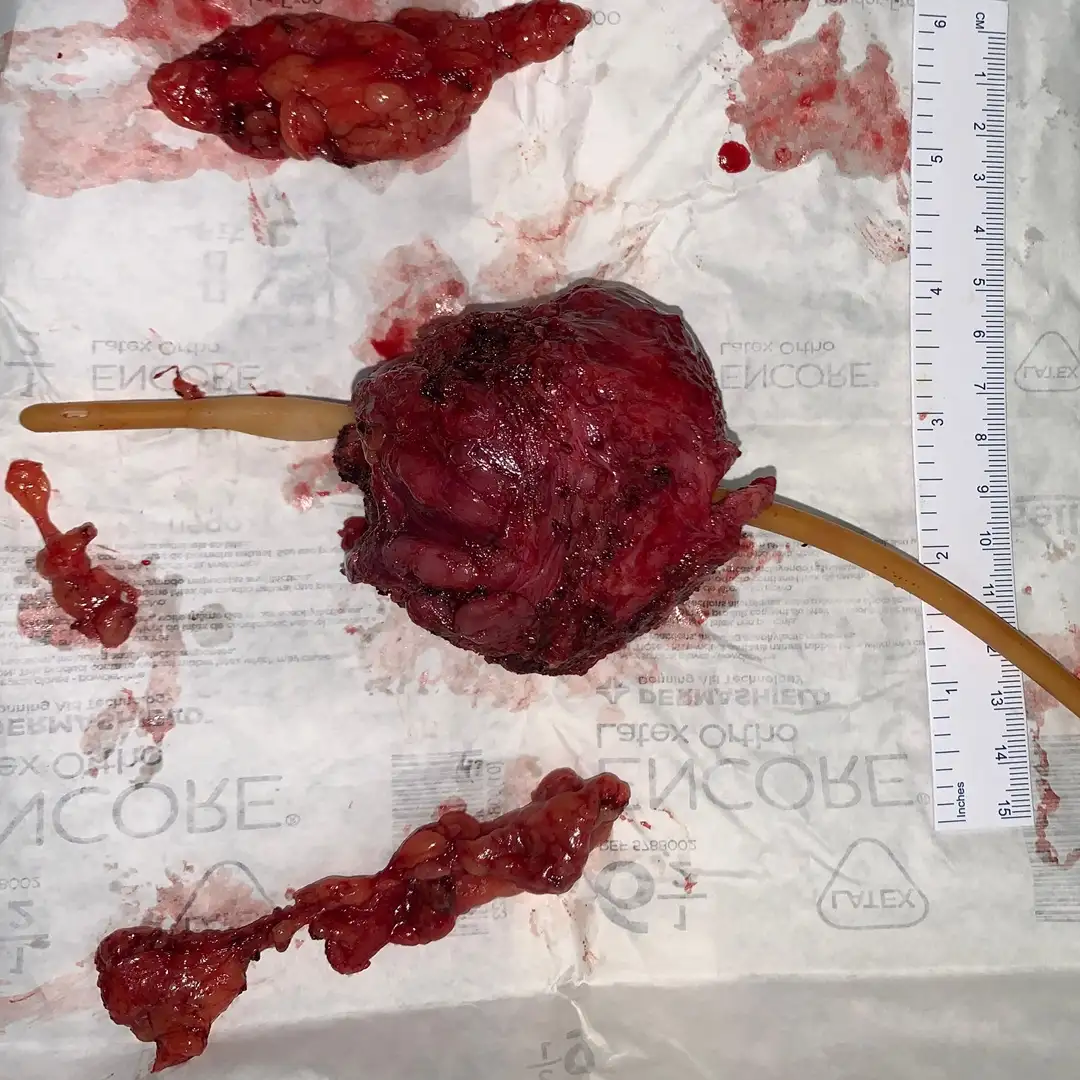
A 67-year-old male presented with urinary urgency and a significantly elevated PSA level of 144.92 ng/ml. Diagnostic imaging and biopsy confirmed an acinar adenocarcinoma, demanding an urgent and highly precise surgical intervention to prevent potential systemic spread while managing the high biochemical risk.
⦿ Robotic-Assisted Radical Prostatectomy and Lymphadenectomy
• Procedure: A minimally invasive radical prostatectomy was executed with unilateral neurovascular bundle preservation.
• Lymph Nodes: A total of 20 pelvic lymph nodes were successfully removed and staged.
• Safety: The surgery was completed with a very low blood loss of 150 ml.
• Cancer Clearance: Pathological examination confirmed negative surgical margins, indicating the complete removal of the tumor.
⦿ Full Oncological Clearance and Early Mobilization
The patient’s postoperative recovery was excellent, characterized by early mobilization and a stable discharge within a few days. Final histopathology confirmed a pT2N0 stage with zero lymph node involvement and no extraprostatic extension. Crucially, the patient achieved early urinary continence, returning to his routine daily activities without significant functional impairment or complications.
By utilizing robotic precision, we achieved complete cancer clearance despite the patient's high pre-operative PSA levels. This approach allowed for meticulous nerve preservation and reconstruction, which are vital for maintaining the patient's quality of life and ensuring a rapid return to normalcy.
Prostate Cancer Video Testimonials
Patient experiences following treatment.
Seeking the best possible medical care, the family consulted with Dr. Swati Shah, an expert Robotic Uro-Gynec Oncologist.
After a thorough consultation, Dr. Shah recommended a Robotic Radical Prostatectomy. The family agreed, and the advanced, minimally invasive surgery was a complete success. Highlighting the rapid recovery associated with robotic procedures, the patient was remarkably discharged from the hospital just two days after the operation.
Vikram reports that all medical tubes and stitches have now been safely removed. His father is experiencing no complications and is feeling significantly better post-surgery.
Prostate Cancer Google Reviews
Patient feedback and experiences.

Prostate Cancer Educational Videos
Short, patient-focused explanations of diagnosis, treatment and recovery.
No. Depending on the risk category and patient factors, active surveillance, surgery or radiation-based treatment may be appropriate.
There are different treatment approaches. Neither should be universally preferred for every patient. The appropriate choice depends on cancer characteristics, patient factors and informed preferences.
For appropriately selected patients, active surveillance is an established management strategy involving structured monitoring and treatment if clinically meaningful progression occurs.
Radiation can be used with curative intent for appropriately selected localized prostate cancer. The exact treatment depends on risk group and patient factors.
Selected patients with high-risk or very-high-risk disease may undergo surgery as part of a broader treatment strategy. These cases require careful staging and multidisciplinary planning.
No. Urinary recovery varies between individuals and depends on baseline function, anatomy, tumour characteristics and surgical factors.
No—but erectile dysfunction is a recognized risk. The possibility of nerve preservation depends primarily on cancer location and extent, not simply on the use of a robot.
Yes. A meaningful second opinion should include review of the biopsy, imaging, PSA history and clinical stage rather than only the diagnosis summary.
If you have recently been diagnosed with prostate cancer and are unsure whether you need active surveillance, surgery or radiation, bring your:
A structured review of these reports can help determine the stage, risk category and appropriate treatment options.
Dr Swati H. Shah
Pelvic (Uro & Gynec) Oncosurgeon
Robotic Uro & Gynec Cancer Surgeon
Apollo Hospital, Ahmedabad
Director, Shah’s Cancer & Robotic Surgery Centre
Director, Indian Ovarian Cancer Institute
18+ years in uro cancer surgery | Robotic surgery since 2013 | 650 radical prostatectomies, including 627 robotic procedures
Swasth Parivar: twice a month, practical advice on recovery, diet and warning signs. No advertising. Stop any time.
Your number is used for these updates and for the clinic to reach you. It is never sold or passed on. To stop, reply STOP on WhatsApp.