Muscle-invasive bladder cancer (MIBC) is bladder cancer that has grown into the muscular layer of the bladder wall. This is different from non-muscle-invasive bladder cancer, which is limited to the inner lining or connective tissue beneath it.
Muscle invasion is an important turning point in treatment planning. The best approach depends on the tumour’s stage, biopsy findings, scans, general health, kidney function and whether the cancer has spread beyond the bladder.
After a TURBT biopsy confirms bladder cancer, the care team reviews the pathology report and imaging to understand how far the disease has spread. Evaluation may include CT or MRI imaging of the abdomen and pelvis, chest imaging, blood tests and assessment of kidney function. The exact tests depend on the case.
The report should be reviewed for tumour type, grade, depth of invasion, whether bladder muscle is present in the sample, and any variant histology or other high-risk features. If the available tissue or imaging does not adequately establish the stage, further evaluation may be needed.
Muscle-invasive disease commonly includes stage T2 or higher local tumour invasion. Lymph-node involvement or distant spread changes the treatment plan and should be assessed before a definitive treatment decision.
Treatment is not the same for every patient. For cancer that has not spread to distant organs, the main options may include systemic treatment followed by radical cystectomy, or a bladder-preserving approach combining maximal TURBT with radiotherapy and chemotherapy in carefully selected patients.
A multidisciplinary team may include a uro-oncologic surgeon, medical oncologist, radiation oncologist, radiologist, pathologist and other specialists. Discussing the options together helps balance cancer control, treatment risks, bladder function and the patient’s priorities.
For eligible patients with muscle-invasive urothelial bladder cancer, cisplatin-based combination chemotherapy before radical cystectomy may improve outcomes. This is called neoadjuvant chemotherapy. It treats cancer cells that may have spread beyond the visible tumour and may reduce the amount of cancer found at surgery.
Suitability depends on factors such as kidney function, hearing, nerve function, general fitness and other medical conditions. Not every patient can safely receive cisplatin-based treatment. The medical oncologist should assess eligibility and explain the expected benefits and risks.
Treatment options and approvals are evolving. Depending on the patient’s eligibility and the applicable local guidance, a specialist team may discuss newer perioperative regimens that combine systemic treatment with surgery. These are not appropriate for everyone, and availability, approval and cost should be checked individually.
Radical cystectomy is an operation to remove the bladder and nearby lymph nodes. The associated operation and urinary reconstruction depend on the patient’s anatomy, tumour location, disease extent and individual circumstances.
For many patients with localised muscle-invasive bladder cancer who are fit for surgery, radical cystectomy is a key curative-intent treatment option, often after recommended preoperative systemic treatment. The aim is to remove the cancer completely when possible.
After the bladder is removed, urine needs a new route out of the body. Options may include an ileal conduit or, in selected patients, an orthotopic neobladder. The choice should be discussed before surgery. The details of cystectomy and urinary diversion are covered separately in the dedicated pages.
Some patients may be suitable for trimodality bladder-preserving treatment. This typically combines maximal TURBT, radiotherapy and chemotherapy given together to make the cancer more sensitive to radiation.
Bladder preservation is not simply TURBT alone, and it requires careful selection, coordinated treatment and long-term surveillance. The approach may be considered when the tumour and patient characteristics are suitable and the patient understands the need for close follow-up and the possibility of later salvage cystectomy.
Bladder-preserving treatment is not appropriate for every tumour. The decision should be made by a multidisciplinary team after discussing the likely benefits, limitations, side effects and alternatives.
Some patients cannot receive cisplatin because of kidney impairment, hearing loss, neuropathy, frailty or other medical reasons. This does not mean that no treatment is available.
The team should assess the patient’s overall fitness and discuss appropriate alternatives. Depending on the clinical situation and current approvals, options may include a different perioperative systemic regimen, proceeding to definitive local treatment, or a bladder-preserving approach in selected cases. Carboplatin should not automatically be considered an equivalent substitute for cisplatin-based neoadjuvant treatment in a curative pathway.
The final pathology report after cystectomy provides important information about the tumour, surgical margins and lymph nodes. These findings, along with any treatment given before surgery, help determine whether additional treatment or surveillance is recommended.
Follow-up is individualised and may include clinical review, imaging, blood tests and monitoring of kidney function, urinary reconstruction and general recovery. Some patients with higher-risk pathology may be considered for additional systemic treatment.
Dr. Swati H. Shah is a uro- and gynaecologic oncosurgeon practising at Apollo Hospital, Ahmedabad, and Shah’s Cancer & Robotic Surgery Centre, Gota. Her bladder cancer practice includes assessment of TURBT and histopathology findings, planning complex pelvic cancer surgery, radical cystectomy and urinary reconstruction, including selected robotic procedures.
Treatment planning should be based on the individual pathology, staging investigations, fitness for systemic treatment and surgery, and the patient’s preferences. A second opinion may help patients understand the sequence of treatment and the options available to them.
No. Radical cystectomy is a major treatment option, but selected patients may be eligible for a bladder-preserving trimodality approach after multidisciplinary assessment.
Not in every case. Preoperative systemic treatment is recommended for many eligible patients, but suitability depends on tumour type, kidney function, overall health and the treatment plan.
TURBT is important for diagnosis and removal of visible tumors, but it is generally not sufficient as definitive treatment for muscle-invasive disease.
Some patients are suitable for an orthotopic neobladder, while others may be better served by an ileal conduit. The choice depends on disease and patient factors.
No. The approach depends on the cancer, prior treatment, anatomy, overall fitness and the surgeon’s assessment. Robotic surgery does not remove the need for appropriate systemic treatment or careful cancer staging.
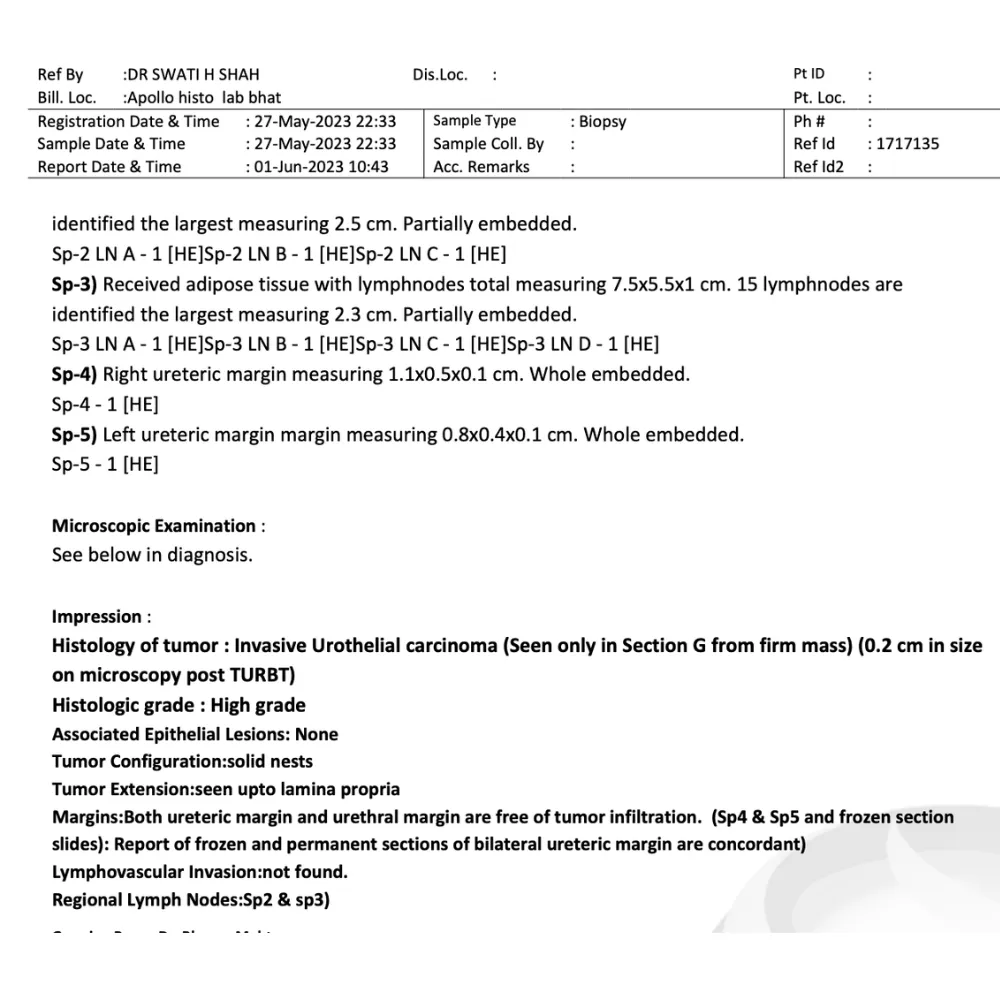
A 68-year-old male patient presented with complaints of recurrent haematuria over a two-month period. Subsequent evaluations and a prior transurethral resection confirmed a diagnosis of muscle-invasive, high-grade papillary urothelial carcinoma. This aggressive malignancy required a highly complex and immediate surgical intervention.
⦿ Robotic Radical Cystoprostatectomy
• Procedure: A robotic radical cystoprostatectomy with an ileal conduit was successfully completed.
• Comprehensive Lymph Node Dissection: Twenty-seven pelvic lymph nodes were meticulously examined and showed zero metastatic involvement.
• Safety and Blood Loss: The advanced robotic platform ensured minimal surgical blood loss, requiring zero blood transfusions.
• Cancer Clearance: Final histopathology confirmed that all surgical margins were completely free of tumor infiltration.
⦿ Successful Recovery And Pathological Clearance
Following the complex procedure, the patient was hemodynamically stable, successfully ambulated on the ward, and demonstrated excellently controlled pain levels. The comprehensive final pathology report definitively confirmed clear surgical margins and absolutely zero regional lymph node spread. Ultimately, he was discharged in a highly stable condition with a functional ileal conduit.
Utilizing the robotic platform for this muscle-invasive cancer allowed us to achieve meticulous oncological clearance. This advanced approach enabled a precise reconstruction, granting the patient the greatest opportunity for a smooth recovery and excellent long-term survival.
This video features a patient testimonial and educational insight from Dr. Swati Shah, a renowned Robotic Uro-Oncologist and Gynecologic Cancer Surgeon. The primary focus of the video is on “Robotic Cystectomy with Neobladder,” a highly advanced surgical procedure used to treat urinary bladder cancer. When a patient’s urinary bladder is entirely removed due to cancer (a procedure called a cystectomy), a major concern is how they will pass urine afterward. The video addresses this critical question by explaining the concept of a “neobladder”—a new bladder surgically created from the patient’s own intestine, allowing them to urinate naturally without the need for an external stoma bag.
The video features a heartwarming and positive patient testimonial dedicated to Dr. Swati Shah, a highly regarded Robotic Uro-Oncologist and Gynecological Cancer Surgeon. It highlights the successful treatment of an elderly patient, who traveled from Kotvada village in the Bhavnagar district of Gujarat to seek specialized medical care. He recently underwent a complex Radical Cystectomy—a major surgical procedure to remove the urinary bladder—for the treatment of urinary bladder cancer under the expert supervision of Dr. Shah at Apollo Hospital. In the brief clip, the patient’s nephew shares their medical journey, explaining that they discovered Dr. Swati Shah’s profile online while searching for the best possible urological cancer treatment.
This video features a heartfelt patient testimonial detailing a successful bladder cancer surgery performed by Dr. Swati Shah, a highly skilled Robotic Uro-Oncologist. In the clip, a patient shares their personal recovery journey following a complex Robotic Radical Cystectomy, a major procedure where a new urinary bladder, known as a neobladder, was surgically created using advanced robotic technology. The patient explains that they underwent this operation two months prior. Although they initially felt anxious and fearful about the potential complications of such a significant medical procedure, the modern robotic approach and Dr. Shah’s expertise made the experience remarkably smooth.
This page provides general educational information and does not replace an individual medical consultation. Treatment recommendations, drug approvals and availability may change. The appropriate plan should be confirmed by the treating multidisciplinary team.
The goal of radical cystectomy is to achieve complete removal of the cancer with adequate surgical margins while addressing possible spread to regional lymph nodes. Careful dissection and attention to anatomical planes are essential to ensure a thorough and safe oncological procedure.
Robotic surgery can provide a magnified 3D view, precise instrument control and enhanced dexterity, which can be particularly useful during complex pelvic cancer surgery. However, the choice of surgical approach depends on the cancer stage, anatomy, patient’s overall condition and the expertise of the surgical team.
The surgical specimen is carefully examined by the pathology team to assess the tumour, lymph nodes and surgical margins. Clear margins are an important component of complete cancer surgery.
With robotic surgery, the surgeon operates using a high-definition 3D, magnified view and specialized instruments that provide enhanced dexterity and precision. This can be particularly valuable during complex pelvic cancer surgery, where careful dissection is required around major blood vessels, nerves and other critical structures.
The procedure shown demonstrates meticulous removal of the bladder and lymph nodes as part of comprehensive cancer surgery. Robotic minimally invasive surgery may offer potential benefits such as smaller incisions, reduced blood loss, less postoperative discomfort and earlier recovery, although the suitability and benefits vary according to the cancer stage, anatomy and overall health of each patient.
Every bladder cancer patient requires an individualized treatment plan based on the tumour characteristics and stage.
Swasth Parivar: every week, practical advice on recovery, diet and warning signs. No advertising. Stop any time.
Your number is used for these updates and for the clinic to reach you. It is never sold or passed on. To stop, reply STOP on WhatsApp.