After radical cystectomy (surgery to remove the urinary bladder), the body needs a new way to store or drain urine. This is called urinary diversion. Two commonly discussed options are an ileal conduit and an orthotopic neobladder.
Patients often ask: “Will I need a urine bag after bladder cancer surgery?” “Can I pass urine normally without a bladder?” and “Which is better—a neobladder or an ileal conduit?” The answer depends on the cancer, medical suitability and the patient’s priorities. Neither option is best for everyone.
An ileal conduit is a urinary diversion made using a short segment of small intestine. The ureters, which carry urine from the kidneys, are connected to this segment. One end is brought through an opening in the abdominal wall called a stoma. Urine flows continuously into an external pouch attached to the skin.
An ileal conduit does not store urine inside the body. The pouch needs regular emptying and routine care, and the stoma and surrounding skin need to be monitored. A stoma nurse can teach patients how to fit and manage the pouch.
People can often return to many usual activities with planning and appropriate support. Having a stoma does not automatically prevent travel, work, exercise or social activities, although individual adjustment and practical preparation are important.
An orthotopic neobladder is a new reservoir created from a segment of intestine and connected to the urethra, the natural urinary passage. In suitable patients, this can allow urine to be passed through the urethra after bladder removal.
A neobladder is not the same as the original bladder. It does not function exactly like a normal bladder, and it usually does not give the same natural sensation of bladder filling. Patients learn a new emptying routine, often using timed voiding rather than waiting for a strong urge.
Some patients experience urinary leakage, particularly at night or during the early recovery period. Others may have difficulty emptying completely and need intermittent catheterisation. Neobladder training, follow-up and realistic expectations are essential.
An ileal conduit drains urine into an external pouch through a stoma. A neobladder stores urine in an internal intestinal reservoir and empties through the urethra, if the patient is suitable.
The ileal conduit generally involves learning stoma and pouch care. The neobladder generally involves learning timed voiding, pelvic-floor and continence strategies where advised, and monitoring for incomplete emptying. Both options require long-term follow-up and attention to kidney function.
Neither option is universally safer, easier or better. The most appropriate diversion is the one that provides sound cancer treatment and can be managed safely in the context of the patient’s health, anatomy and preferences.
Not every patient is suitable for an orthotopic neobladder. The surgeon considers whether the urethra can be safely preserved, whether the cancer involves the bladder neck or urethra, kidney function, bowel health, general fitness, ability to learn the emptying routine and the patient’s ability to manage potential complications.
Selected patients may not be advised to have a neobladder if the cancer involves the urethra or a safe cancer operation would be compromised, if kidney or bowel function is significantly impaired, or if other health or practical factors make the diversion unsuitable. The decision requires individual assessment; one factor alone does not always determine eligibility.
An ileal conduit may be a suitable choice for many patients, including some who are not candidates for a neobladder or who prefer a more straightforward emptying system. It may be considered when the urethra cannot be used for a neobladder, when the patient’s health or functional circumstances favour a conduit, or when the patient prefers external drainage.
An ileal conduit still requires learning stoma care and managing a pouch. Patients should discuss dexterity, vision, mobility, support at home, skin care and personal preferences with their care team and stoma nurse.
Patients often ask whether they can work, travel, exercise, sleep comfortably, swim or maintain an active social life after bladder removal. Many people return to meaningful daily activities with either diversion, but the adjustment, practical routines and possible limitations differ.
With an ileal conduit, patients learn pouch emptying, changing the appliance and protecting the skin around the stoma. With a neobladder, patients learn a regular voiding schedule, monitor for leakage and recognise signs of incomplete emptying or infection. Both groups need follow-up and may need support while adapting.
Recovery, continence, energy levels and quality of life vary between individuals. It is helpful to discuss work, travel, sleep, exercise, body image, sexual health and caregiver support before surgery rather than assuming that one diversion will suit everyone.
With an ileal conduit, potential issues include skin irritation, leakage around the appliance, stoma narrowing or retraction, hernia near the stoma, urinary infection and changes in kidney function.
With a neobladder, potential issues include daytime or nighttime leakage, difficulty emptying, the need for intermittent catheterisation, urinary infection, mucus production and metabolic or kidney-related problems. The exact risks depend on the patient and the reconstruction.
Both diversions use a segment of intestine and require follow-up. The treating team may monitor kidney function, electrolytes, urinary symptoms, infection risk and other issues relevant to the reconstruction. Seek medical advice promptly for fever, flank pain, inability to drain or pass urine, or a major change in urinary output.
Dr. Swati H. Shah is a uro- and gynaecologic oncosurgeon practising at Apollo Hospital, Ahmedabad, and Shah’s Cancer & Robotic Surgery Centre, Gota. Her bladder cancer practice includes radical cystectomy and urinary reconstruction, including ileal conduit and selected neobladder procedures.
Patients considering bladder removal should discuss the cancer treatment plan and urinary diversion together. The aim is to select an option that is oncologically appropriate, medically safe and realistic for the patient’s daily life. The decision should be made after reviewing the pathology, imaging, urethral suitability, kidney and bowel function, general health and personal priorities.
Neither is best for everyone. The decision depends on cancer-related factors, health, anatomy and patient preferences.
No. Some patients are suitable for a neobladder that drains through the urethra; others need an ileal conduit with an external pouch.
Urine may pass through the urethra, but emptying is different from normal bladder function. Timed voiding is often needed, and some patients require catheterisation.
No. Cancer location, urethral involvement, kidney and bowel function, overall fitness and other factors determine suitability.
Many people can return to travel and exercise with planning, appropriate supplies and advice from their care team.
No. Leakage and incomplete emptying can occur, and outcomes vary between patients.
Yes. Long-term follow-up is important for both options, including monitoring kidney function and diversion-related problems.
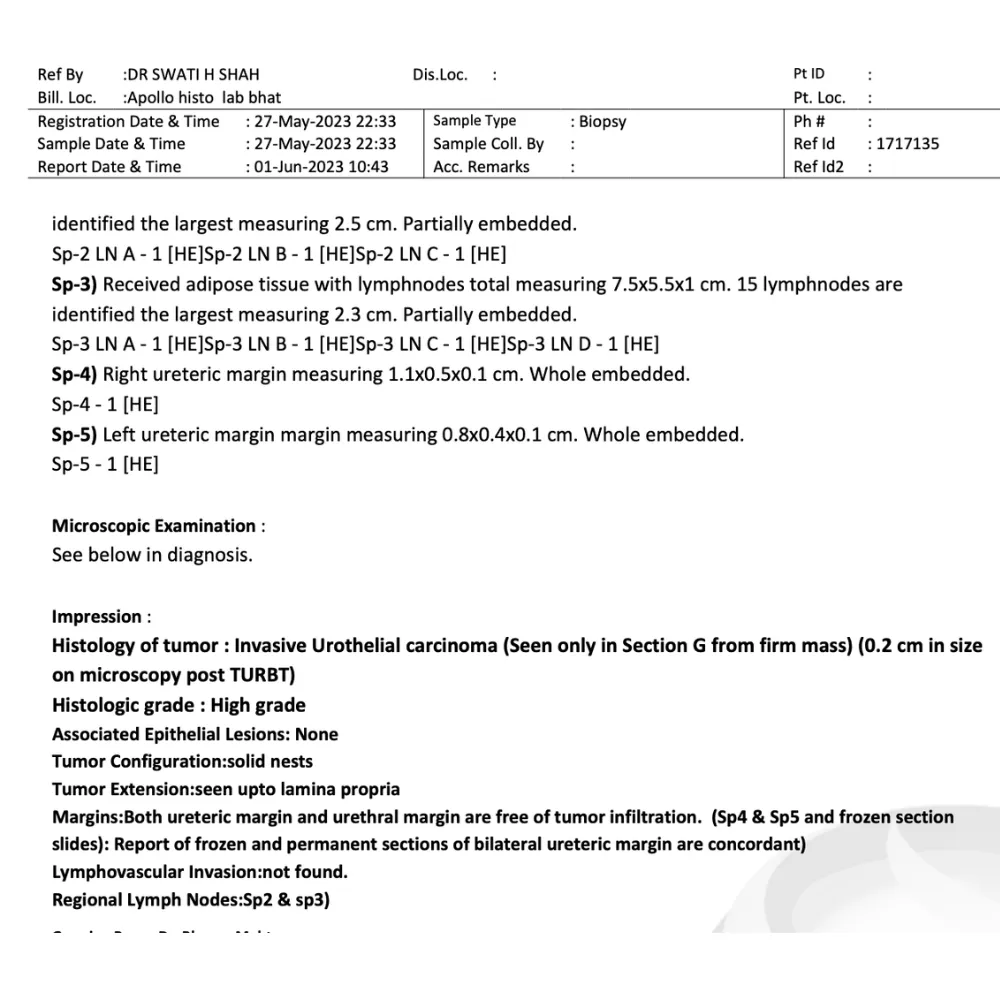
A 68-year-old male patient presented with complaints of recurrent haematuria over a two-month period. Subsequent evaluations and a prior transurethral resection confirmed a diagnosis of muscle-invasive, high-grade papillary urothelial carcinoma. This aggressive malignancy required a highly complex and immediate surgical intervention.
⦿ Robotic Radical Cystoprostatectomy
• Procedure: A robotic radical cystoprostatectomy with an ileal conduit was successfully completed.
• Comprehensive Lymph Node Dissection: Twenty-seven pelvic lymph nodes were meticulously examined and showed zero metastatic involvement.
• Safety and Blood Loss: The advanced robotic platform ensured minimal surgical blood loss, requiring zero blood transfusions.
• Cancer Clearance: Final histopathology confirmed that all surgical margins were completely free of tumor infiltration.
⦿ Successful Recovery And Pathological Clearance
Following the complex procedure, the patient was hemodynamically stable, successfully ambulated on the ward, and demonstrated excellently controlled pain levels. The comprehensive final pathology report definitively confirmed clear surgical margins and absolutely zero regional lymph node spread. Ultimately, he was discharged in a highly stable condition with a functional ileal conduit.
Utilizing the robotic platform for this muscle-invasive cancer allowed us to achieve meticulous oncological clearance. This advanced approach enabled a precise reconstruction, granting the patient the greatest opportunity for a smooth recovery and excellent long-term survival.
This video features a patient testimonial and educational insight from Dr. Swati Shah, a renowned Robotic Uro-Oncologist and Gynecologic Cancer Surgeon. The primary focus of the video is on “Robotic Cystectomy with Neobladder,” a highly advanced surgical procedure used to treat urinary bladder cancer. When a patient’s urinary bladder is entirely removed due to cancer (a procedure called a cystectomy), a major concern is how they will pass urine afterward. The video addresses this critical question by explaining the concept of a “neobladder”—a new bladder surgically created from the patient’s own intestine, allowing them to urinate naturally without the need for an external stoma bag.
The video features a heartwarming and positive patient testimonial dedicated to Dr. Swati Shah, a highly regarded Robotic Uro-Oncologist and Gynecological Cancer Surgeon. It highlights the successful treatment of an elderly patient, who traveled from Kotvada village in the Bhavnagar district of Gujarat to seek specialized medical care. He recently underwent a complex Radical Cystectomy—a major surgical procedure to remove the urinary bladder—for the treatment of urinary bladder cancer under the expert supervision of Dr. Shah at Apollo Hospital. In the brief clip, the patient’s nephew shares their medical journey, explaining that they discovered Dr. Swati Shah’s profile online while searching for the best possible urological cancer treatment.
This video features a heartfelt patient testimonial detailing a successful bladder cancer surgery performed by Dr. Swati Shah, a highly skilled Robotic Uro-Oncologist. In the clip, a patient shares their personal recovery journey following a complex Robotic Radical Cystectomy, a major procedure where a new urinary bladder, known as a neobladder, was surgically created using advanced robotic technology. The patient explains that they underwent this operation two months prior. Although they initially felt anxious and fearful about the potential complications of such a significant medical procedure, the modern robotic approach and Dr. Shah’s expertise made the experience remarkably smooth.
This page provides general educational information and does not replace an individual medical consultation. Suitability for urinary diversion must be assessed by the treating team. The choice should never compromise appropriate cancer removal.
A neobladder is created after removal of the urinary bladder for bladder cancer. The intestine is carefully fashioned into a reservoir and connected to the urinary tract, allowing urine to be stored and passed through the natural urinary passage.
The aim of this reconstruction is to provide a more natural way of passing urine and, where possible, good urinary control. However, a neobladder is not suitable for every patient. The decision depends on factors such as the type and stage of bladder cancer, tumour location, urethral involvement, kidney function, overall health, and the patient’s ability to manage the reconstruction.
In this video, you can see the surgical process involved in neobladder reconstruction, along with a patient sharing their experience after surgery.
Urine continuously drains through the stoma into a specially designed collection bag. The stoma itself does not cause pain because it does not have the same sensation as normal skin. The collection bag is securely attached to the abdomen and is designed to provide a leak-resistant seal, allowing patients to go about their daily activities with confidence.
One of the biggest concerns for patients is whether they will be able to wear normal clothes and return to their usual lifestyle. With appropriate stoma care and the right fitting of the appliance, many patients can wear their regular clothing, work, travel, exercise and participate in everyday activities.
An ileal conduit is not simply a change in the way urine leaves the body—it is a reconstruction designed to help patients regain independence and maintain a good quality of life after bladder cancer surgery.
Swasth Parivar: every week, practical advice on recovery, diet and warning signs. No advertising. Stop any time.
Your number is used for these updates and for the clinic to reach you. It is never sold or passed on. To stop, reply STOP on WhatsApp.