
Case Library › Testis › Undescended testis in an adult
In short: an adult patient had an undescended, partially atrophied left testis lying in the left superficial inguinal region on ultrasound. Dr Swati Shah performed a left inguinal orchidectomy with testicular prosthesis placement in one operation. Recovery was uneventful and histopathology showed no evidence of malignancy. Patient identity is not disclosed.
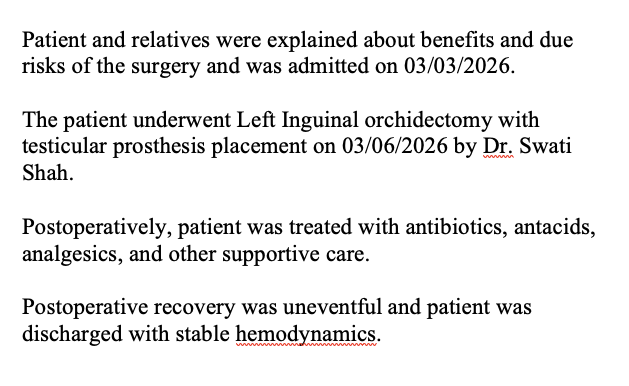
| Condition | Undescended (cryptorchid) and partially atrophied left testis in an adult |
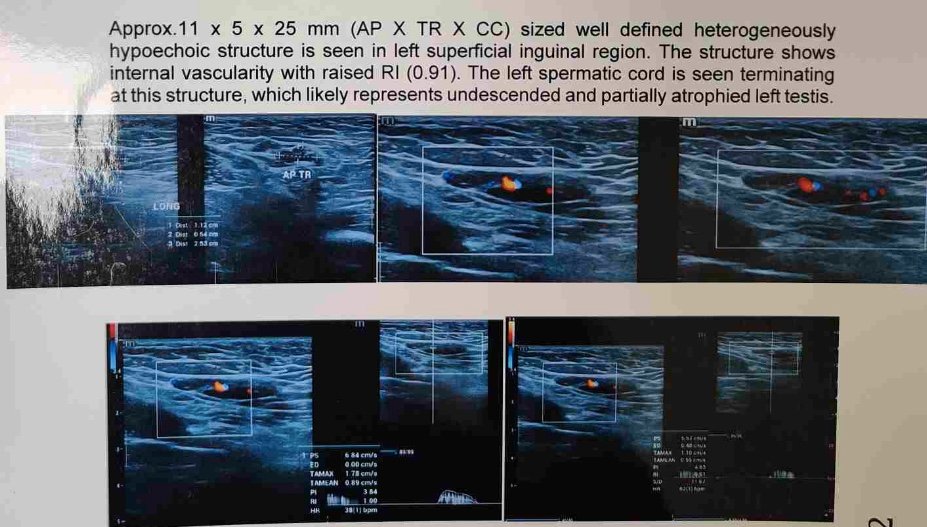
| Ultrasound | Left superficial inguinal region, about 11 x 5 x 25 mm, heterogeneously hypoechoic, internal vascularity; spermatic cord ends at it |
| Operative finding | Atrophied left testis, 10 x 15 mm, at the left superficial inguinal ring; right testis normal in scrotum |
| Procedure | Left inguinal orchidectomy with testicular prosthesis placement, general anaesthesia, inguinal skin-crease incision |
| Blood loss | 5 mL, no transfusion |
| Recovery | Uneventful; wound clean, pain controlled, ambulatory at discharge |
| Histopathology | No evidence of malignancy (no cancer found) |
| Surgeon | Dr Swati Shah, Uro-Oncologist and Surgical Oncologist, Ahmedabad |
An undescended testis (cryptorchidism) is a testicle that has not reached its normal position in the scrotum. In this case, ultrasound showed an undescended and partially atrophied left testis in the left superficial inguinal region, and at surgery it measured 10 x 15 mm, while the right testis was normal in the scrotum.
On imaging the left testis lay in the superficial inguinal region rather than the scrotum and was described as partially atrophied. At operation it was small (10 x 15 mm) and atrophied, whereas the right testis was normal and in the scrotum. Position and size were confirmed both on ultrasound and directly during surgery.
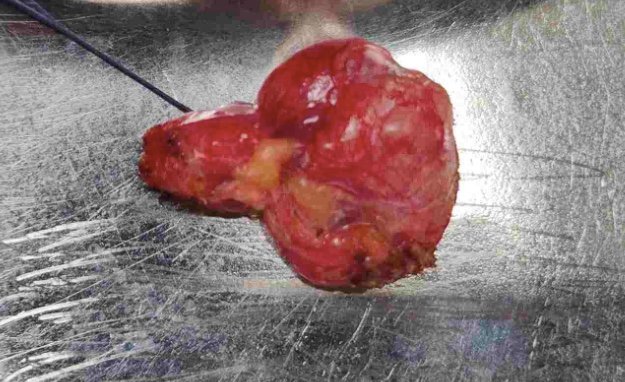
The operation was done under general anaesthesia through a left inguinal skin-crease incision. The atrophied testis was found at the left superficial inguinal ring, the cord structures were identified, ligated and divided, and the testis was removed. Blood loss was 5 mL and no blood transfusion was needed.
Related reading: radical inguinal orchidectomy (the same inguinal approach, used for testicular cancer) and testicular cancer symptoms, diagnosis and tumour markers.
Yes. After the left testis was removed, a space was created in the left scrotal sac and a solid synthetic testicular prosthesis was placed and fixed in the same operation, followed by layered wound closure. The prosthesis is a reconstructive step, separate from treating the undescended testis itself.
Ultrasound of the abdomen and pelvis reported an undescended and partially atrophied left testis in the left superficial inguinal region, about 11 x 5 x 25 mm, well defined, heterogeneously hypoechoic, with internal vascularity and the left spermatic cord ending at this structure. There was no significant lymphadenopathy or ascites; the bladder was normal and the prostate was normal in size.
Recovery was uneventful. The patient received supportive medicines, was ambulatory with stable haemodynamics, the wound was clean and pain was controlled at discharge. Wound dressing was advised after three days and follow-up after seven days in the oncology OPD.
The removed left testis was sent for histopathology (microscopic examination). The histopathology report showed no evidence of malignancy, meaning no cancer was found in the removed testis.
Undescended testis is most often found in infancy and childhood, but it can persist into adulthood. A testis that stays outside the scrotum is generally associated with a higher risk of testicular cancer than a normally placed testis, which is one reason doctors follow these patients and sometimes advise surgery. What is right depends on the position and size of the testis, the other testis, imaging, age and the patient's own wishes. This page describes one case and is not a recommendation for any other patient. Read more from the NHS and MedlinePlus.
See also testicular cancer surgery in Ahmedabad, a second opinion for testicular conditions, more cases in the Testis case library and the Clinical Case Library and FAQs. To book a consultation, contact the clinic.
Patient identity is protected: no name, age or hospital number is shown. The discharge summary excerpt is reproduced from the original record. This page is for education and does not replace a consultation. Outcomes differ from patient to patient.
Swasth Parivar: every week, practical advice on recovery, diet and warning signs. No advertising. Stop any time.
Your number is used for these updates and for the clinic to reach you. It is never sold or passed on. To stop, reply STOP on WhatsApp.